AboutEnterprise solutionsGet the app
Free walking tour · Gothic Quarter · Barcelona

Walk the Barri Gòtic,
your way.

Free Gothic Quarter walking tour - cathedral, Roman walls, Plaça del Rei, in 30 seconds

Your free walking tour of Barcelona's medieval old town - the 14th-century cathedral, the Roman walls still standing after 1,700 years, the courtyard where Columbus reported to the Catholic Monarchs, the square where the 1938 air raid is still pockmarked on the wall. Pick a walk below or tell us a theme. Works offline, 9 voiced languages, 30 free minutes on signup.

Or pick your walk

Gothic Quarter essentials

Cathedral + Sant Jaume + Plaça del Rei + Sant Felip Neri + Plaça Reial. 3.5 hours.

Barcelona Cathedral

1298-1448 Catalan Gothic. 1887-1913 neogothic facade. Cloister with 13 geese for the 13-year-old St Eulàlia. Roof €3.

Roman Barcino

Temple of Augustus columns (Carrer del Paradís 10) + Roman walls (Plaça Nova) + underground forum (MUHBA).

Plaça Sant Jaume

The Roman forum. 14c Ajuntament + 15c Generalitat (oldest functioning government building in Europe). Political heart of Catalonia.

Plaça del Rei

Saló del Tinell - where Columbus reported to Ferdinand and Isabella, April 1493. Royal chapel of Santa Àgata. King Martí tower.

Plaça Sant Felip Neri

Hidden behind the cathedral. 30 Jan 1938 fascist air raid - 42 dead, mostly children. Shrapnel marks still on the church facade.

Carrer del Bisbe bridge

The most photographed view in Barcelona. NOT medieval - 1928 neogothic by Rubió i Bellver (Gaudí follower). Skull-and-dagger under it.

Plaça Reial

1848 arcaded neoclassical square. Gaudí's first public commission (1879) - the two 6-armed lampposts. Palm trees, fountain.

El Call (Jewish quarter)

Europe's oldest surviving synagogue (3c-13c). Narrow medieval streets - Sant Domènec del Call, Marlet. 1391 pogrom ended the community.

Santa Maria del Pi

1322-1453 Catalan Gothic. Single nave. 10-metre rose window (largest of its kind in the world). Bell tower €5.

Build your own walk →

Type a theme, an angle, a question - we'll build the walk in 30 seconds.

Local knowledge

What we'd tell you on day one

Six things that change how you walk the Barri Gòtic.

01

The Gothic Quarter is partly fake (and that's fine).

The name "Barri Gòtic" was coined in 1908. The romantic medieval atmosphere you walk through was deliberately curated in the 1920s and 1930s under a city-restoration project led by Adolf Florensa - he relocated medieval facades, demolished post-medieval buildings to "reveal" Gothic ones, added neogothic elements (the Carrer del Bisbe bridge, the cathedral's main facade itself), and removed Renaissance and Baroque overlays. The medieval bones are real (the cathedral, Plaça del Rei, Santa Maria del Pi, the Roman remains). The medieval coherence isn't. Once you know to look, you can spot it: too-perfect Gothic facades on tall windows, masonry too clean, the famous skull-and-dagger relief under the Bisbe bridge in a strikingly modern style. The fake-medieval is a 20th-century romantic-nationalist creation - and a beautiful one.

02

The cathedral roof gives the best view.

Three Gothic Quarter viewpoints, ranked: (1) Barcelona Cathedral roof - €3 lift from inside the cathedral, you walk between the gargoyles with the spires above and the medieval skyline all around, the best view of any old town in Spain; (2) Santa Maria del Pi bell tower - €5 climb, smaller view but right above Plaça del Pi; (3) the Mirador del Rei Martí (King Martí tower) on top of Plaça del Rei - access only via special MUHBA exhibitions, but if it's open take it. Cathedral roof is open 13:00-17:30 (weekdays) when it's part of the tourist visit; doors close 16:30.

03

Eat where the cathedral choir eats.

Tourist food in the Gothic Quarter is terrible by Barcelona standards - the area has the highest density of bad-paella sangria-jug restaurants in the city. But the locals still eat in the neighbourhood at the addresses they keep to themselves. Best vermouth: Bodega La Plata (Carrer de la Mercè 28 - 1927, four tapas only, never changes); Bar Pinotxo at the Boqueria edge. Best tapas: Cervecería Catalana annex on Carrer del Pi for a quick bite. Best lunch menu: Caelum (Carrer de la Palla 8 - in an old convent, also sells convent biscuits). Best old-school: Can Culleretes (Carrer Quintana 5 - since 1786, the oldest restaurant in Barcelona).

04

Roman Barcino is the secret.

Most visitors walk past the Roman remains and miss them. Three things you must see: (1) Temple of Augustus - four 9-metre granite columns from 15 BC, hidden inside the courtyard of a residential building at Carrer del Paradís 10 (free, signposted from Plaça Sant Jaume, look for the millstone in the doorway marking the highest point of Roman Barcino); (2) the Roman walls - chunks visible at Plaça Nova (the two round towers flanking the cathedral entrance), Plaça Ramon Berenguer III (best preserved stretch with medieval houses built on top), Plaça dels Traginers (the corner tower); (3) the underground city at MUHBA Plaça del Rei - 4,000 sq metres of intact Roman streets, wine presses, garum factory, laundry. €7 ticket; allow 90 minutes.

05

El Call is a 13-second walk and 1,000 years of history.

The medieval Jewish quarter ("El Call") was the densest Jewish community in medieval Catalonia - maybe 4,000 people at its 13th-century peak, in a tiny area between Plaça Sant Jaume and the cathedral. The 1391 pogrom destroyed the community; the Jews were officially expelled from Spain in 1492. The Sinagoga Major (Carrer Marlet 5) is one of the oldest surviving synagogue buildings in Europe - Roman foundations, used as a synagogue 3rd-13th century, converted to other uses, identified and restored as a synagogue 1996. €4 visit. The medieval Jewish street plan still exists: walk Carrer de Sant Domènec del Call and Carrer de Marlet between Plaça Sant Jaume and the cathedral.

06

Get lost. The map doesn't help.

The Gothic Quarter is small (600 metres across) but the streets are narrow, the grid is medieval, and Google Maps gets confused in the alleys. The best Gothic Quarter walks happen when you stop navigating and let the streets pull you. The neighbourhood doesn't have many wrong turns - everything connects, no street is more than 4 minutes from a landmark, and the back alleys (Carrer del Bisbe, Carrer del Paradís, Carrer dels Banys Nous, Carrer Avinyó) are usually more interesting than the through-streets. Mornings before 10 are best - the cathedral is empty, the cafés have their first coffees, the streets are quiet. By noon the cruise-ship crowds arrive.

How it works

How iWander walks the Gothic Quarter with you.

Three things, in 30 seconds.

iWander home screen

01

Type your walk.

Any sight, theme or vibe. "Cathedral roof and cloister geese", "Roman Barcino in 90 minutes", "Civil War bomb wall", "Plaça del Rei + Columbus", "El Call Jewish quarter", "Plaça Reial Gaudí lampposts". iWander writes you the walk in 30 seconds.

iWander audio walk in progress

02

Hear the story as you walk.

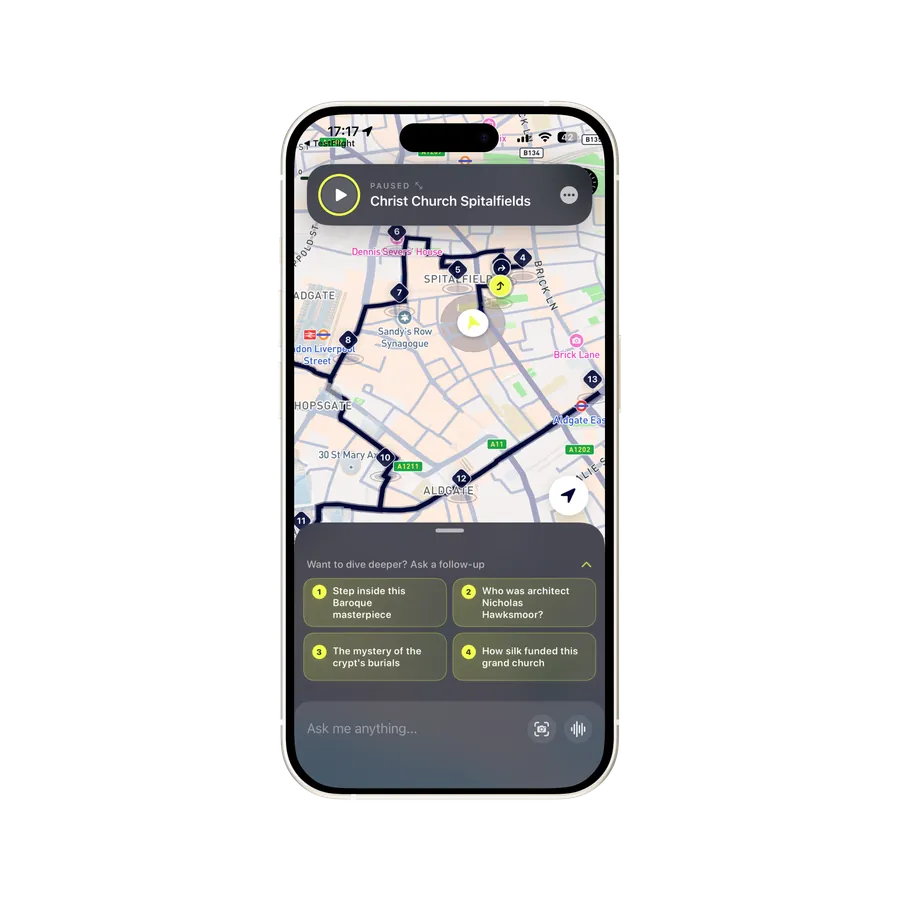
The 15 BC Augustan foundation of Barcino, the 4th-century Roman walls, the 13th-century Counts of Barcelona, the 1391 pogrom against El Call, the 1493 Columbus reception, the 1714 War of Succession, the 1908 invention of "the Gothic Quarter", the 1928 neogothic bridge, the 1938 Sant Felip Neri bombing - 2,000 years on a single 600-metre street.

iWander on-demand AI guide

03

Ask anything along the way.

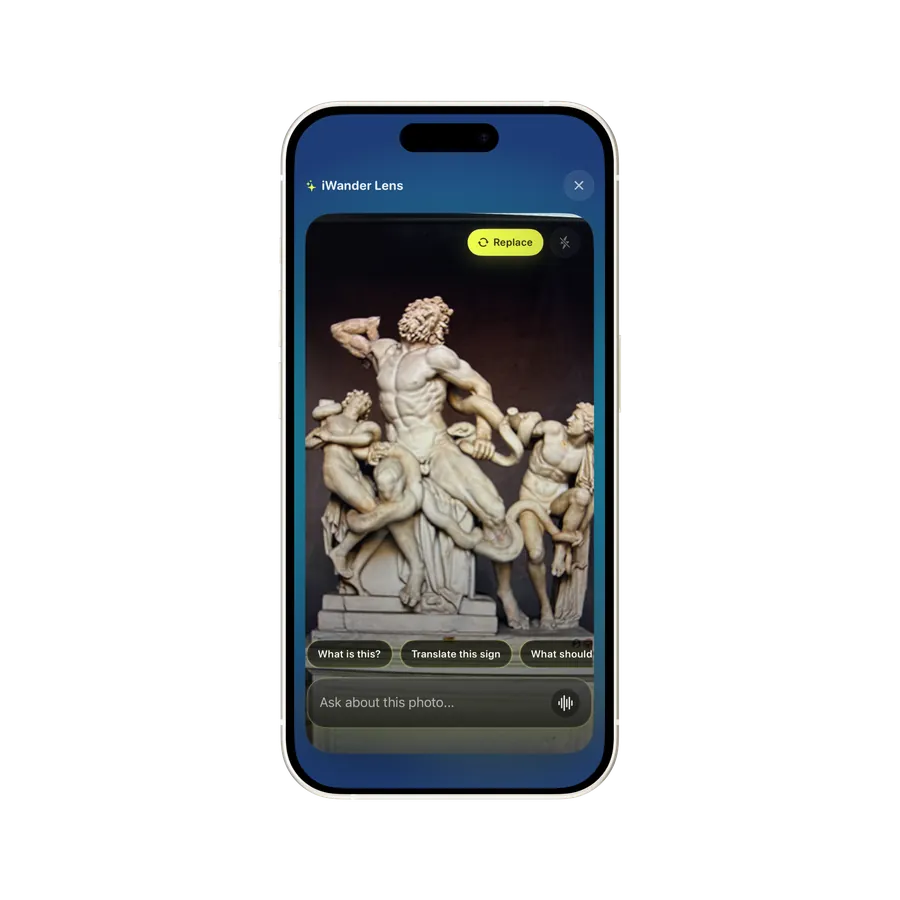
Why 13 geese? When was the cathedral facade built? Where's the Roman temple? What happened in 1938? Point your camera, ask out loud, or type. Your guide answers in seconds.

Works offline · 9 voiced languages · 30 free minutes on signup

What makes it worth walking

2,000 years on 600 metres - the Roman colony that became the medieval Catalan capital that became the romantic restoration

The Barri Gòtic is the densest historical layering in Barcelona. The medieval cathedral, the 14th-century royal palace, the surviving Catalan parliament, the Roman walls, the Roman temple columns, the underground forum, the medieval Jewish quarter, the 1938 Civil War bombing - all in a 600-metre square between La Rambla and Via Laietana. The name "Gothic Quarter" itself is only about 120 years old. The medieval coherence the streets project is partly real and partly a 1920s romantic restoration. The result is more atmospheric than honest, and more beautiful than the documentary truth. Walk it slowly enough and you can read the layers without needing the labels.

Roman Barcino

Barcelona was founded as the Roman colony Barcino about 15 BC, under Augustus, as a small but strategically-placed coastal settlement on the Via Augusta between Hispania Tarraconensis and Gaul. The colony was tiny - about 12 hectares, maybe 4,000 residents - planned as a textbook Roman castrum with a forum at the cardo-decumanus intersection (today's Plaça Sant Jaume), a Temple of Augustus on the highest point (the Mons Tabor, today's Carrer del Paradís), and a rectangular wall circuit with four gates. The 4th-century walls were a major upgrade against German incursions: 2 metres thick, 9 metres tall, 78 towers around the 1.4 km perimeter.

You can still see significant chunks of Roman Barcino. The four columns of the Temple of Augustus stand inside the courtyard of an ordinary residential building at Carrer del Paradís 10 - 9 metres tall, 1.4 metres in diameter, untouched since the 1st century BC. The two round Roman towers at Plaça Nova flanking the cathedral approach are part of the original 4th-century wall circuit. The Plaça Ramon Berenguer III stretch (along Via Laietana) has the best-preserved length of Roman wall in the city - with medieval houses built directly on top, you can read the layers from the road below. Underneath the Plaça del Rei, the MUHBA museum exposes 4,000 sq metres of intact Roman streets - garum (fish sauce) factories, wine presses, a laundry, a 4th-century basilica. Together they preserve more visible Roman Barcelona than almost any other modern Mediterranean city.

The medieval county and kingdom

After the Visigothic and Moorish periods (the Moors briefly held Barcelona 711-801), the Frankish Carolingians took the city back in 801 and made it the capital of the Spanish March - a frontier county between the Franks and Al-Andalus. The Counts of Barcelona slowly accreted power and territory through the 9th-12th centuries, becoming hereditary, then sovereign, then (through the 1137 marriage of Ramon Berenguer IV to Petronilla of Aragon) joint rulers of the Crown of Aragon. By the 13th-14th centuries Barcelona was the largest city in the western Mediterranean - the trading capital of an empire that controlled Sardinia, Sicily, southern Italy, Athens, parts of North Africa.

This was the golden age that built the Gothic Quarter you see now. The cathedral of Santa Creu i Santa Eulàlia was started 1298 and consecrated 1448 - 150 years of construction in pure Catalan Gothic. The Palau Reial Major (the royal palace, now Plaça del Rei) was rebuilt 13th-14th centuries as the official residence of the Counts of Barcelona / Kings of Aragon. The Saló del Tinell - the great hall of the palace, with its six 17-metre stone arches - was built 1359-1370 for King Pere III. The Generalitat (Catalan parliament) was founded 1359 and has met in the same building on Plaça Sant Jaume continuously since 1418 - the oldest medieval government building in Europe still functioning as a government. Santa Maria del Pi (1322-1453) and Santa Maria del Mar (1329-1383, just across in El Born) are the two other great Catalan Gothic churches of the era.

El Call and the 1391 pogrom

Medieval Barcelona had one of the largest Jewish communities in Catalonia - maybe 4,000 people at its 13th-century peak, living in a tightly-packed quarter ("El Call", from the Latin "callis", narrow lane) between Plaça Sant Jaume and the cathedral. The community was prosperous and protected: court physicians, financiers, scholars, the philosopher Hasdai Crescas. The Sinagoga Major on Carrer Marlet (3rd-13th century use) is one of the oldest surviving synagogue buildings in Europe.

The Black Death of 1348 set off a wave of anti-Jewish blame across Catalonia. In August 1391 a violent pogrom in Seville spread to Barcelona; the mob stormed El Call on 5 August, killed about 300 Jews, looted the quarter, and forced most survivors to convert to Christianity. The community never recovered. The remaining Jews were officially expelled from Spain in 1492 under Ferdinand and Isabella. The Sinagoga Major was converted to other uses for 600 years and only re-identified and restored as a synagogue in 1996. The narrow medieval Jewish street plan still exists - walk Carrer Sant Domènec del Call, Carrer Marlet, Carrer de la Volta del Remei, and you're in the medieval Jewish district.

Columbus reports to the Catholic Monarchs

In April 1493 Christopher Columbus returned to Spain from his first transatlantic voyage and was summoned to court by Ferdinand and Isabella, who were spending the spring in Barcelona. The reception took place, according to local tradition, in the Saló del Tinell of the Palau Reial Major - the great hall above Plaça del Rei. Columbus presented the king and queen with gold, parrots, indigenous people he had brought back, and his maps of what he believed to be the Indies. The historical record on whether the reception was actually in the Tinell hall is mixed - some sources say it was in a different room - but the tradition is strong and the Tinell is the building. Stand in Plaça del Rei and you stand 5 metres below the floor where the Spanish empire began.

The 1714 catastrophe

The War of the Spanish Succession (1701-1714) was, from the Catalan perspective, a disaster. Catalonia backed the Habsburg claimant against the Bourbon Philippe V. After a 14-month siege Barcelona fell to the Bourbon army on 11 September 1714. Philippe V abolished the Generalitat, banned the Catalan language in official use, demolished the entire neighbourhood of La Ribera to build a fortress (the Ciutadella), and imposed direct Castilian rule. 11 September - "La Diada" - is still Catalonia's national day, marking the 1714 defeat. Catalan recovered slowly through the 19th century (the Renaixença movement), and the Generalitat was re-established in 1932 under the Second Republic. Franco abolished it again in 1939; it was re-established for the third time after Franco's death in 1977 and continues today on Plaça Sant Jaume.

The 1908 invention of "the Gothic Quarter"

Through the 19th century the old town was densely populated, partly slum, with no particular name - just "the old part". By 1900 it was a candidate for demolition - the urban planner Ildefons Cerdà had drawn the Eixample grid in 1859 with the expectation that the medieval city would be progressively cleared.

Then in 1908 the architect Lluís Domènech i Montaner and others coined the term "Barri Gòtic" - "Gothic Quarter" - as part of a Catalan-nationalist romantic-restoration agenda. The idea was to use the medieval bones to project a noble Catalan past (Catalan Gothic as the architectural expression of Catalan national identity). Through the 1920s and 1930s the city architect Adolf Florensa led a programme of selective demolition and restoration: he demolished post-medieval buildings to "reveal" Gothic ones, moved medieval facades from demolition sites to vacant slots in the Gothic Quarter, added neogothic elements to dignify the streetscape (the Carrer del Bisbe bridge, 1928, by Joan Rubió i Bellver, is the most famous), and built the neogothic main facade of the cathedral (1887-1913, designed by Josep Oriol Mestres).

The result is the Barri Gòtic as it looks today - more architecturally coherent than it was medieval, more atmospheric than honest, beautiful in a way the medieval original wasn't quite. The medieval bones are real (the cathedral interior, Santa Maria del Pi, Plaça del Rei, the royal chapel, the Generalitat courtyards, the surviving Roman elements). The medieval-feeling continuity isn't always real. Once you know the difference, you can read it - the too-perfect facades, the too-clean stone, the slightly-too-elegant Gothic windows. The fake-medieval is itself a historical layer now, a century old.

The 1938 bombing

On 30 January 1938, during the Spanish Civil War, Italian fascist aircraft flying for Franco bombed central Barcelona. Two bombs landed on Plaça Sant Felip Neri - the tiny hidden square behind the cathedral - hitting the church of Sant Felip Neri and the children's school next door. 42 people died, mostly children sheltering in the church basement. The shrapnel marks are still on the church facade. A plaque on the wall remembers the dead. The square is the most affecting spot in the Gothic Quarter - quiet, often empty, the shrapnel marks raw on the baroque stone. Stand in front of the plaque for a minute. Barcelona has many beautiful monuments. This one is small, ugly, and important.

Questions

Frequently asked

The Barri Gòtic - the Gothic Quarter - is Barcelona's medieval old town, between La Rambla (west) and Via Laietana (east). It sits directly on top of the Roman colony of Barcino (founded c. 15 BC) and you can still see chunks of the 4th-century Roman walls, the columns of the Temple of Augustus, and Roman foundations under the MUHBA museum. The medieval town was built 13th-15th century; the "Gothic Quarter" name was coined in 1908 and much of what looks medieval is actually 1920s-30s neogothic restoration in a medieval matrix.
A full walk - cathedral, Roman walls, Temple of Augustus, Plaça Sant Jaume, Plaça del Rei, Plaça Sant Felip Neri, Carrer del Bisbe, Plaça Reial - takes 3 to 3.5 hours. A focused walk (cathedral + Plaça del Rei + Plaça Sant Jaume) is 90 minutes. The neighbourhood is small (about 600 metres across) but the streets are narrow and you get lost happily.
The Catedral de la Santa Creu i Santa Eulàlia - the seat of the Archbishop of Barcelona, built 1298-1448 in Catalan Gothic. The neogothic facade is 1887-1913. Single nave, 28 side chapels, a Gothic cloister with 13 geese (one for each year of the 13-year-old Saint Eulàlia, the city's co-patron). Roof €3 - the best Gothic Quarter view. Cathedral free in the morning for prayer, €11 for the tourist visit. Daily 09:30-18:30.
(1) The four 1st-century columns of the Temple of Augustus, hidden inside the courtyard at Carrer del Paradís 10 (free); (2) chunks of the 4th-century Roman walls at Plaça Nova, Plaça Ramon Berenguer III, and Plaça Traginers; (3) the underground Roman city at the MUHBA Plaça del Rei - 4,000 sq metres of Roman foundations, garum factories, wine presses, the original 4c basilica. €7 ticket.
The Roman forum of Barcino, now the political heart of Catalonia. North side: the Palau de la Generalitat (Catalan government, in continuous use since the 15th century - the oldest medieval government building in Europe still functioning as a government). South side: the Ajuntament (Barcelona city hall). The Generalitat is open to visit on the 2nd and 4th weekends of every month - free, queue ahead.
The medieval Royal Square - the courtyard of the Palau Reial Major. The dominant building is the 14th-century Saló del Tinell where, according to tradition, Columbus reported to Ferdinand and Isabella in April 1493 after returning from his first voyage. The 1302 Gothic chapel of Santa Àgata and the 16th-century watchtower of King Martí frame the square. The MUHBA museum entrance opens here.
The neogothic stone bridge crossing Carrer del Bisbe between the Generalitat and the Casa dels Canonges - the most-photographed image in the Gothic Quarter. NOT medieval: designed in 1928 by Joan Rubió i Bellver, a follower of Gaudí, in deliberate neogothic style. The skull-and-dagger relief beneath the bridge is part of the original 1928 design.
A tiny hidden square behind the cathedral. The pockmarked church facade preserves the marks of a deliberate Italian fascist air-raid bombing on 30 January 1938 during the Spanish Civil War - 42 people, mostly children sheltering in the church basement, were killed. The marks on the facade are real shrapnel impacts. A plaque on the wall remembers the dead.
Metro: Liceu (Line 3) on La Rambla is the western entry; Jaume I (Line 4) on Via Laietana is the eastern entry. Drassanes (Line 3) is the southern entry. From Barcelona airport: Aerobús to Plaça de Catalunya (35 min, €7.25) then walk south five minutes, or R2 Nord train to Passeig de Gràcia (28 min, €4.90).

How to find it

Getting to the Barri Gòtic

District
Ciutat Vella (Old City) · postal code 08002
Nearest metro
Liceu (L3, green) on La Rambla; Jaume I (L4, yellow) on Via Laietana; Drassanes (L3) south; Urquinaona (L1, L4) north-east
From Barcelona airport (BCN)
Aerobús A1/A2 to Plaça de Catalunya (35 min) · €7.25. Or R2 Nord train to Passeig de Gràcia (28 min) · €4.90
From Girona airport (GRO)
Sagalés bus to Estació del Nord (75 min) · €17
Best season
April-June and September-October. July-August hot and crowded. December for the Fira de Santa Llúcia Christmas market at the cathedral steps
When to walk
Cathedral 09:30-18:30 (Sundays open later). MUHBA Tue-Sun 10-19. Mornings before 10 best for empty streets. Sant Felip Neri quietest mornings before 11

The headline sights

Three landmarks to anchor your walk

Pull the audio walk around any of these and the rest of the Gothic Quarter falls into place.

Barcelona Cathedral (Santa Creu i Santa Eulàlia)

Pla de la Seu. 1298-1448 Catalan Gothic body, 1887-1913 neogothic facade. Single nave, 28 side chapels, the cloister with 13 geese. The crypt holds the tomb of the 13-year-old Saint Eulàlia. Roof access €3 - the best Gothic Quarter view. Free entry 08:30-12:30 and 17:45-19:30 for prayer; €11 tourist visit including roof, cloister, treasury.

Walk the cathedral

Plaça del Rei + MUHBA (the Roman city underground)

The medieval Royal Square: 14c Saló del Tinell (Columbus's reception room), 1302 chapel of Santa Àgata, King Martí watchtower. The MUHBA Museum entrance opens here. Below: 4,000 sq metres of intact Roman streets - 1st-century garum factory, wine presses, laundry, the original 4c basilica. €7 ticket; allow 90 minutes underground.

Walk Plaça del Rei

Plaça Sant Jaume + Carrer del Bisbe

The political square: the 14c Ajuntament (city hall) facing the 15c Generalitat (Catalan parliament, the oldest medieval government building in Europe still functioning as a government). 30 metres north on Carrer del Bisbe: the famous 1928 neogothic bridge by Rubió i Bellver. The Generalitat is open to visit on the 2nd and 4th weekends of every month - free, queue ahead.

Walk Plaça Sant Jaume

Other Barcelona neighbourhoods to wander

Walk somewhere else in Barcelona

Build any Gothic Quarter walk you want.

Tell us a theme, a question, a vibe - the cathedral roof, the Roman walls, the medieval royal palace, the 1938 bombing wall, the El Call Jewish quarter, a vermouth tapas crawl - and your walk is ready in 30 seconds.

Get the iWander app

30 free minutes on signup · Subscriptions from $10/mo · Cancel anytime

Updated 20 May 2026 by the iWander local team · Curated for accuracy