AboutEnterprise solutionsGet the app
Free walking tour · Île de la Cité · Paris

Walk the Île de la Cité,
your way.

Free Île de la Cité walking tour - Notre-Dame, Sainte-Chapelle, Conciergerie, Pont Neuf, in 30 seconds

Your free walking tour of Paris's birthplace - the 9-hectare island where Lutetia began, where Notre-Dame stands, where Saint Louis built his gem of a chapel for Christ's crown, and where Marie Antoinette spent her last weeks. Pick a walk below or tell us a theme and your audio tour is ready in 30 seconds. Works offline, 9 voiced languages, 30 free minutes on signup.

Or pick your walk

Local knowledge

What we'd tell you on day one

Six things that change how you walk the islands.

01

Book Notre-Dame ahead.

Since the 8 December 2024 reopening, Notre-Dame remains free to enter but uses a timed-entry system to manage crowds. Book your slot on the cathedral's website (notredamedeparis.fr) up to 48 hours in advance - it takes 30 seconds. Walk-ins are accepted when capacity allows but you may queue 30-60 minutes. Mass attendees enter via a separate side door without booking.

02

Sainte-Chapelle at noon, ideally sunny.

The upper chapel - 75 percent stained glass - was designed to be lit by the sun. The colours peak between 11:00 and 14:00 on a clear day, especially in spring or autumn. Cloudy days are still beautiful but quieter. Book a slot online to skip the security queue at the Palais de Justice gate (it's the same gate the courts use - tight security). Combined ticket with the Conciergerie next door is €20 - worth it.

03

The Mémorial de la Déportation is silent.

Behind Notre-Dame, at the eastern tip of the island. A small entry, a long descending stair, a triangular hall lined with 200,000 lit crystals - one for each French citizen deported to Nazi camps. There are no audio guides; speaking inside is discouraged. Free. Open daily 10:00-12:00 and 14:00-17:00, closed Mondays in winter. Allow 20 silent minutes.

04

Walk the islands east to west.

Start at the Pont Sully (east end of Île Saint-Louis), walk west along Quai d'Orléans (the south bank of Saint-Louis), eat a Berthillon ice cream on Rue Saint-Louis-en-l'Île, cross the Pont Saint-Louis (the pedestrian bridge with the buskers), pass behind Notre-Dame past the Memorial, do the cathedral, cut north to the Marché aux Fleurs, west to Sainte-Chapelle and Conciergerie, end at Pont Neuf and the Square du Vert-Galant. That's the canonical order; allow 3 hours.

05

Berthillon is closed Mondays and Tuesdays.

The historic ice-cream maker at 31 Rue Saint-Louis-en-l'Île has been here since 1954. They close Monday and Tuesday and the whole month of August - which is when half the cafés on the island that buy their ice cream from Berthillon also close. The flavours that matter: chocolat noir, salted caramel, marrons (chestnut, in autumn), framboise (raspberry). On a hot day the queue runs to the corner; the locals know to walk one block to one of the cafés that resells (look for the Berthillon plaque on the door).

06

Place Dauphine is the island's secret park.

Tucked behind the Pont Neuf and the Conciergerie, the triangular Place Dauphine is one of central Paris's quietest squares. Built 1607 by Henri IV as the partner to Place des Vosges (in the Marais), it was meant to be the same style; today most of the original buildings have been altered but the triangular shape and the chestnut trees survive. Locals play boules under the trees. Brasserie La Rose de France or Le Caveau du Palais are real Paris brasseries with no view but proper food.

How it works

How iWander walks the islands with you.

Three things, in 30 seconds.

iWander home screen

01

Type your walk.

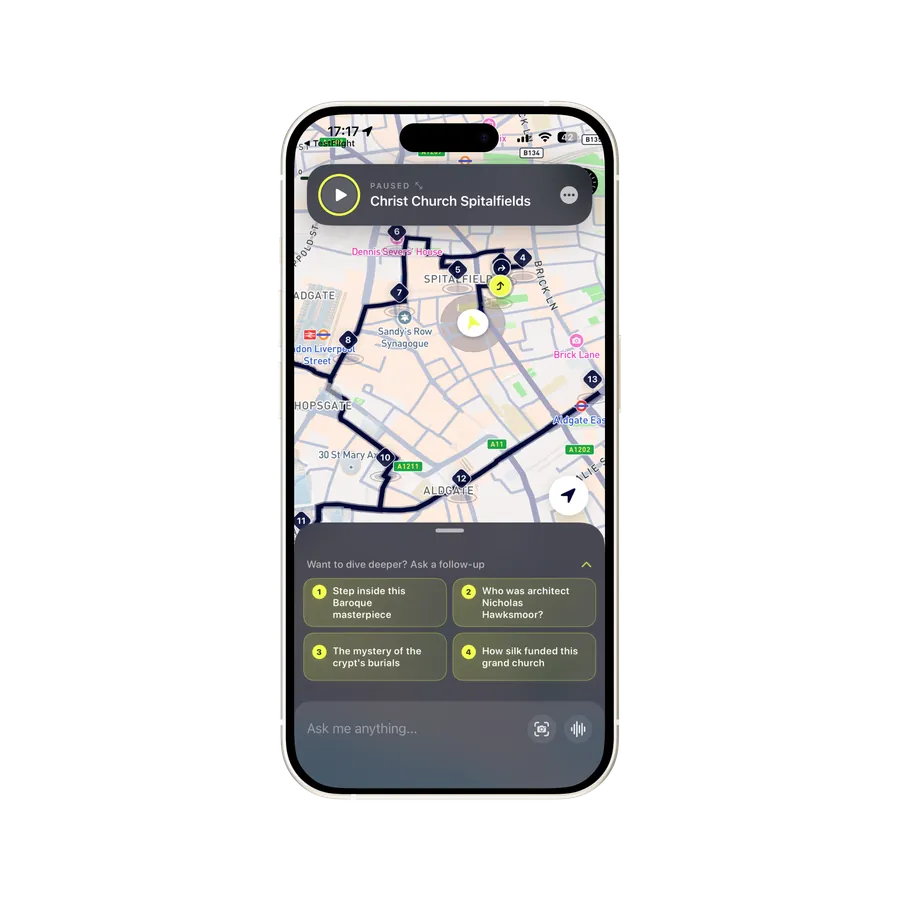
Any landmark, theme or vibe. "Notre-Dame reopening", "Sainte-Chapelle stained glass", "Marie Antoinette's cell", "Berthillon and Île Saint-Louis", "Pont Neuf at sunset". iWander writes you the walk in 30 seconds.

iWander audio walk in progress

02

Hear the story as you walk.

The Parisii Celts in 250 BC, Roman Lutetia, the medieval kings at the Conciergerie, Saint Louis with the Crown of Thorns, Henri IV opening the Pont Neuf in 1607, the Revolution, Hugo's Notre-Dame, the 19th-century restoration, the 2019 fire, the 2024 reopening.

iWander on-demand AI guide

03

Ask anything along the way.

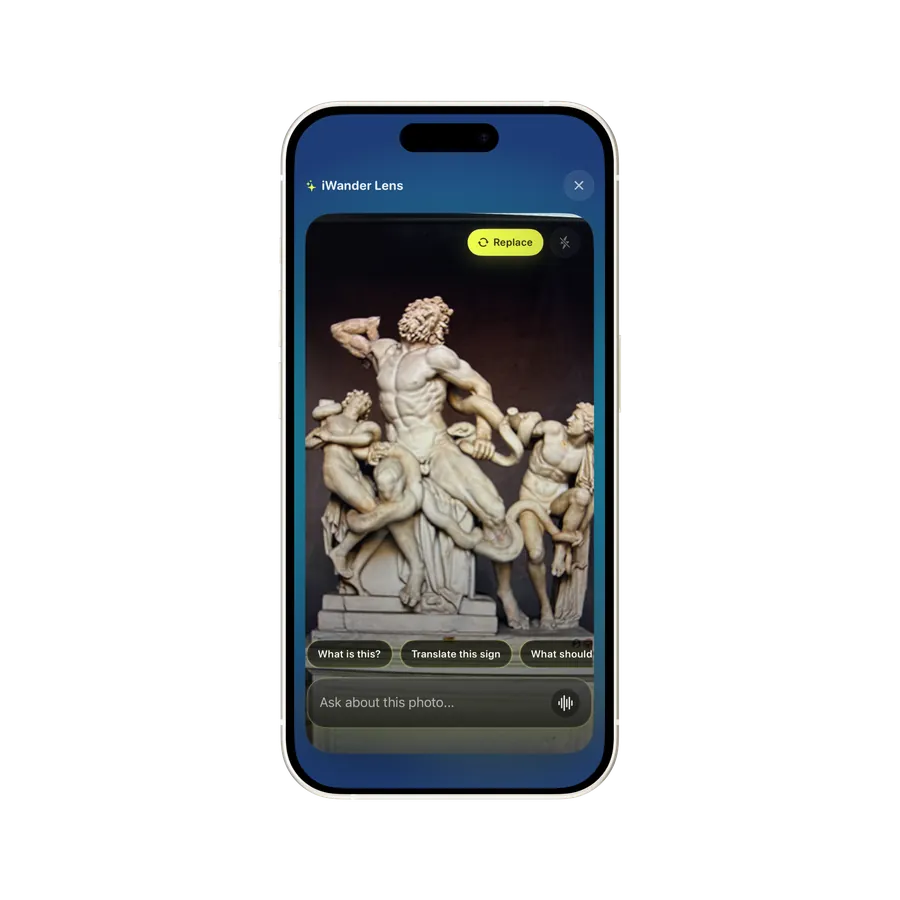
Whose statue? Which gargoyle? When was that built? Point your camera, ask out loud, or type. Your guide answers in seconds.

Works offline · 9 voiced languages · 30 free minutes on signup

What makes it worth walking

Two islands, two thousand years, and the city that grew around them

Every Paris story starts on the Île de la Cité. Around 250 BC a Celtic tribe called the Parisii built a settlement on this 9-hectare island in the middle of the Seine - it was easier to defend than the marshy banks. When Julius Caesar arrived in 53 BC he called the place Lutetia and made it the regional capital. When Clovis became the first king of the Franks in 508 AD he made it his royal seat. When Hugues Capet started the dynasty that gave France its first 800 years of monarchs in 987, the royal palace stood where the Conciergerie stands now. The Île de la Cité is, quite literally, the spot Paris began.

The medieval island

By 1200, the island was a small medieval city in its own right - the royal palace and Sainte-Chapelle on the western half, the cathedral chapter and Bishop's Palace on the eastern half, in between a packed neighbourhood of narrow streets, half-timber houses, taverns, schools and the medieval Hôtel-Dieu hospital (Paris's first, founded 651 AD - though the current building is 19th-century, it stands on the same spot). The chapter wanted to build a great cathedral, and in 1163 Bishop Maurice de Sully laid the foundation stone for Notre-Dame. The cathedral took 182 years to finish (1163-1345); by the time it was complete the medieval city had grown around it.

The medieval royal palace expanded westward. In 1239 King Louis IX (Saint Louis) acquired what he believed was Christ's Crown of Thorns from the Latin Emperor of Constantinople, who needed cash, and Louis paid more for the crown than he later paid for the entire Sainte-Chapelle to house it. Built in just six years (1242-1248), Sainte-Chapelle is the most concentrated piece of medieval craftsmanship in northern Europe: the upper chapel walls are 75 percent stained glass, 1,113 panels telling Old and New Testament scenes from the Creation to the Apocalypse, supported on improbably slender stone ribs. The Crown of Thorns is no longer here - it was moved to Notre-Dame, was rescued from the 2019 fire by chaplain Jean-Marc Fournier, and is now in the cathedral treasury again, behind glass.

The royal palace becomes a prison

The kings of France moved out of the Île de la Cité palace in 1370 - Charles V preferred the Louvre, then the Hôtel Saint-Pol, and his successors gradually abandoned the medieval complex altogether. The palace became a courts and a prison; the Concierge (the keeper of the palace, hence "Conciergerie") ran a small jail in the basement. By the time of the Revolution, the Conciergerie was the city's main holding prison: prisoners awaiting trial at the Revolutionary Tribunal upstairs were held in the medieval cells below. Marie Antoinette spent the last six weeks of her life here, from August to October 1793, in a tiny cell now reconstructed as a chapel; she was beheaded at the Place de la Concorde on 16 October. Robespierre, who had sentenced her, was held in the same prison and beheaded ten months later, on the same square.

Haussmann clears, Viollet-le-Duc restores

By 1860 the medieval island was a slum - the houses around Notre-Dame were dilapidated, the streets narrow, the Hôtel-Dieu hospital cramped and unsanitary. Baron Haussmann, Napoleon III's prefect of the Seine, demolished almost the entire medieval neighbourhood on the island. The current Place du Parvis Notre-Dame (the open square in front of the cathedral) was made by tearing down five medieval streets and a hospital. The Hôtel-Dieu was rebuilt as a single vast 1877 block. Place Louis-Lépine (today the Marché aux Fleurs) was opened up. Whole streets - Rue Neuve-Notre-Dame, Rue de la Vieille-Drapière - simply ceased to exist.

At the same time, Eugène Viollet-le-Duc was restoring Notre-Dame. The cathedral was a wreck by 1840 - the Revolution had decapitated all 28 statues of the Kings of Judah on the facade (the heads were dumped in a courtyard and only rediscovered in 1977; they're now in the Cluny museum), the spire had been removed in 1786, the interior was used as a warehouse during the Revolution. Victor Hugo's 1831 novel The Hunchback of Notre-Dame galvanised public opinion and started the restoration. Viollet-le-Duc spent 25 years on it (1845-1870) and added the spire we now think of as iconic - a 19th-century construction in 13th-century style. That same spire fell on 15 April 2019.

The fire, and the reopening

At 18:50 on Monday 15 April 2019 a fire broke out in the roof structure of Notre-Dame, almost certainly from an electrical short during renovation. The 13th-century oak rafters (the "forest", an irreplaceable medieval forest of timber) burned through. The 96-metre spire collapsed at 19:50, falling through the vaulting. The fire was finally extinguished at 09:00 the next morning. By then the spire was gone, the roof was gone, much of the vaulting had collapsed, the great organ was choked with toxic lead dust - but the stone walls, both towers, all three rose windows, the great organ casing, and the wooden choir stalls had survived. Within 24 hours President Macron pledged the cathedral would reopen in five years.

The reconstruction was a national project. 2,000 craftsmen and labourers, 1,000 oak trees felled across France for the new "forest" of the roof, 1,200 sculptors and stone-cutters trained or retrained. The spire was reconstructed exactly to Viollet-le-Duc's 1859 design - not modernised. The interior was deep-cleaned (lead dust was the major challenge). New stained glass for the six lateral chapels was commissioned but the decision was deferred in 2024. On Sunday 8 December 2024 - just under five and a half years after the fire - the cathedral reopened to the public. Mass is back. Entry is free. The treasury, including the rescued Crown of Thorns, is back behind glass. The towers will reopen in 2026.

The smaller, quieter Île Saint-Louis

The island just east of the Cité is the Île Saint-Louis - smaller (11 hectares to the Cité's 9, just one street long instead of three), much quieter, completely different in character. Originally two undeveloped pasture islands; the developer Christophe Marie was given permission in 1614 to merge them, build embankments, lay out streets and put up identical 17th-century townhouses. The work was finished by 1664. The island has barely changed since: same street plan, same buildings, no tour buses, a few hundred residents, one church (Saint-Louis-en-l'Île, baroque, surprisingly grand), and Berthillon. Hemingway lived briefly at 71 Rue Cardinal Lemoine just off the Pont Sully. Daumier lived here. Rothschild had a townhouse. Today it is the city's most expensive postcode per square metre - and a 20-minute walk from end to end.

Questions

Frequently asked

Yes - Notre-Dame de Paris reopened to the public on 8 December 2024, five and a half years after the April 2019 fire. The interior is fully restored, including the spire (reconstructed identically to Viollet-le-Duc's 1859 original), the choir, the rose windows (which survived the fire), and the great organ. Entry is free; booking ahead via the cathedral's website is strongly recommended to avoid queues. The treasury and the towers require separate paid tickets. Mass is celebrated daily and Sunday.
Yes - the upper chapel is unforgettable. Built 1242-48 by Louis IX (Saint Louis) to house Christ's Crown of Thorns and other Passion relics, the upper chapel is 75 percent stained glass - 1,113 panels telling the Old and New Testaments, mostly original 13th-century. On a sunny day around noon the colours are overwhelming. About €13; combined Conciergerie+Sainte-Chapelle ticket €20; free for under-18s and EU residents under 26. Allow 45-60 min.
The medieval royal palace on the western end of the island. From 1190 to 1370 it was the residence of the kings of France; afterwards it became a prison. During the Revolution (1793-95) it held over 2,700 prisoners - including Marie Antoinette in the autumn of 1793, in a tiny cell now reconstructed as a chapel. Today open as a museum: the vast 14c Salle des gens d'armes (the largest medieval secular hall in Europe), the kitchens, the women's prisoners' yard, Marie Antoinette's cell. About €13.
Paris's oldest standing bridge, paradoxically named 'New Bridge' because it was the newest when finished in 1607 by Henri IV. Stone, twelve arches (seven on the north side, five on the south), the first bridge in Paris built without houses on it - which meant pedestrians had real views of the river for the first time. The Square du Vert-Galant at the western tip of the island is the prow-shaped park beneath the bridge - a free, quiet picnic spot at river level. Open 24h.
The smaller, quieter Seine island just east of the Île de la Cité, connected by the Pont Saint-Louis pedestrian bridge. Originally two undeveloped islands; built up in a single 17th-century planning push (1614-1664) by Marie de Médici's planners; it has barely changed since. Today: a few hundred residents, two main streets, one church (Saint-Louis-en-l'Île), 4-5 small hotels, and Berthillon - the historic ice-cream maker at 31 Rue Saint-Louis-en-l'Île, since 1954. The whole island can be walked in 20 minutes.
A 1962 memorial at the eastern tip of the Île de la Cité, behind Notre-Dame, commemorating the 200,000 French men, women and children deported from France to Nazi concentration camps between 1941 and 1944. Architect: Georges-Henri Pingusson. A small entry, a long narrow stairway, a triangular hall lined with 200,000 lit crystals. Free, open daily 10:00-17:00 (closed Mondays in low season). One of the most moving spaces in Paris.
Métro: Cité (line 4) drops you at the Marché aux Fleurs in the middle of the island; Saint-Michel-Notre-Dame (4, RER B+C) is just across the bridge on the Left Bank; Pont Neuf (line 7) is at the western tip; Hôtel de Ville (1, 11) is on the Right Bank, three minutes' walk over the Pont d'Arcole. From CDG, RER B to Saint-Michel-Notre-Dame, about €12. The whole island is walkable in 15 minutes.
Yes. Download a walk over Wi-Fi at your hotel before you head out. French SIMs (Orange, Free Mobile) are cheap and 4G coverage is excellent across central Paris. iWander runs entirely on-device once downloaded.

How to find it

Getting to the islands

Arrondissement
1st (western Cité, Conciergerie + Sainte-Chapelle); 4th (Notre-Dame, Île Saint-Louis)
Nearest métro
Cité (4), Saint-Michel-Notre-Dame (4, RER B+C), Pont Neuf (7), Pont Marie (7), Hôtel de Ville (1, 11)
From CDG airport
RER B to Saint-Michel-Notre-Dame (35 min) · about €12
From Orly
Orlyval + RER B to Saint-Michel-Notre-Dame (45 min) · about €15
Best season
April-June and September-October. Notre-Dame is busiest July-August + 8 December anniversary
When to walk
Notre-Dame 09:00 or 17:00 slot. Sainte-Chapelle on a sunny noon. Vert-Galant at sunset. Berthillon any Wed-Sun afternoon.

The headline sights

Three landmarks to anchor your walk

Pull the audio walk around any of these and the rest of the island falls into place.

Notre-Dame de Paris

6 Parvis Notre-Dame, the eastern half of the island. Built 1163-1345, restored after the 2019 fire and reopened 8 December 2024. Free entry, timed booking via notredamedeparis.fr. Mass daily, daily organ recital. Treasury and towers paid (towers reopen 2026).

Walk the cathedral

Sainte-Chapelle

10 Boulevard du Palais, inside the courtyard of the Palais de Justice. Built 1242-48 by Louis IX. The upper chapel - 75% stained glass, 1,113 panels - is one of medieval Europe's masterpieces. €13, combined with Conciergerie €20. Book ahead; security queue.

Walk Sainte-Chapelle

The Conciergerie

2 Boulevard du Palais. Medieval royal palace till 1370, then the prison where Marie Antoinette spent her last six weeks. Open daily 09:30-18:00. €13. The 14c Salle des gens d'armes (largest medieval secular hall in Europe), the kitchens, Marie Antoinette's reconstructed cell.

Walk the Conciergerie

Other Paris neighbourhoods to wander

Walk somewhere else in Paris

Build any Cité walk you want.

Tell us a theme, a question, a vibe - Notre-Dame post-reopening, Sainte-Chapelle stained glass, Marie Antoinette's cell, Berthillon on Saint-Louis, a sunset at the Vert-Galant - and your walk is ready in 30 seconds.

Get the iWander app

30 free minutes on signup · Subscriptions from $10/mo · Cancel anytime

Updated 19 May 2026 by the iWander local team · Curated for accuracy