AboutEnterprise solutionsGet the app
Free walking tour · Covent Garden · London

Walk Covent Garden,
your way.

Free Covent Garden walking tour - Piazza, Opera House, Seven Dials, in 30 seconds

Your free walking tour of London's first piazza - Inigo Jones's 1631 Italian-style square turned 400-year-old market turned theatre district. Pick a walk below or tell us a theme. Works offline, 9 voiced languages, 30 free minutes on signup.

Or pick your walk

Local knowledge

What we'd tell you on day one

Six things that change how you walk Covent Garden.

01

Walk from Leicester Square, not Covent Garden tube.

Covent Garden tube (Piccadilly Line) is one of London's most-photographed but most-frustrating stations. It exits via lifts (no escalators) and queues build to 15-20 minutes on weekends. Use Leicester Square instead (Northern + Piccadilly Lines, multiple exits, escalators) and walk east along Long Acre or south through the Charing Cross Road blocks - 4 minutes and you're at the Piazza.

02

The Apple Market changes weekly.

The East Colonnade of the Market Building hosts an Apple Market - vetted craftspeople, not retailers - with a different theme on different days. Mondays is antiques (the longest-running theme since 1974), Tuesday-Sunday is handmade crafts. The stalls rotate so the same vendors don't camp the same spot. Photography is welcome; haggling is gentle but accepted. The Jubilee Market on the south side is more touristy.

03

St Paul's Church is the actors' church.

The white-stoned church on the west side of the Piazza (the back faces the square, the entrance is on Bedford Street) is St Paul's Covent Garden - the "actors' church" since the 17th century, when the parish was the theatreland of London. Memorial plaques inside commemorate Vivien Leigh, Boris Karloff, Charlie Chaplin (whose father was Cockney music-hall here), Noël Coward, Diana Dors, Hattie Jacques, Sybil Thorndike. Open most days 09:00-17:00; free. The west garden behind the church is one of central London's quietest free spaces.

04

Royal Opera House tickets start at £4.

The cheapest seats - "amphitheatre standing" or "balcony standing" - are genuinely £4 to £8 for many performances. They give you a partial view but full sound (the acoustics in the upper amphitheatre are excellent). You stand the whole performance. Best for shorter productions (75 min one-acts, ballet single acts). Book online up to 4 months ahead for the popular performances. The same-day standing tickets sometimes sit in the box office at the door from 90 minutes before curtain.

05

Neal's Yard is a Monday-Wednesday secret.

The colourful courtyard photographs perfectly empty - meaning Mondays, Tuesdays and Wednesdays before 11:00. Saturdays it's a queue. The Salad Bar (Wild Food Café), Monmouth Coffee (the original shop is 2 blocks south on Monmouth Street), and Neal's Yard Remedies (the founding shop is here, still selling natural cosmetics since 1981) are the worthwhile stops. The dancer's-paradise yard photo (the one you see on Instagram) is taken from the south entrance off Monmouth Street.

06

Lamb & Flag is the locals' pub.

33 Rose Street - tucked down a narrow alley off Garrick Street. The Lamb & Flag is the oldest pub in Covent Garden (the licence dates from 1772 but a tavern has been on this spot since at least 1623). Dickens drank here. The interior is small, low-ceilinged, mostly unchanged. Real ale, a small food menu, no music, no TV. Open every day; the side alley fills with drinkers on warm evenings. Avoid the chain Wetherspoon pub at the south-east corner of the Piazza, which is the tourist trap.

How it works

How iWander walks Covent Garden with you.

Three things, in 30 seconds.

iWander home screen

01

Type your walk.

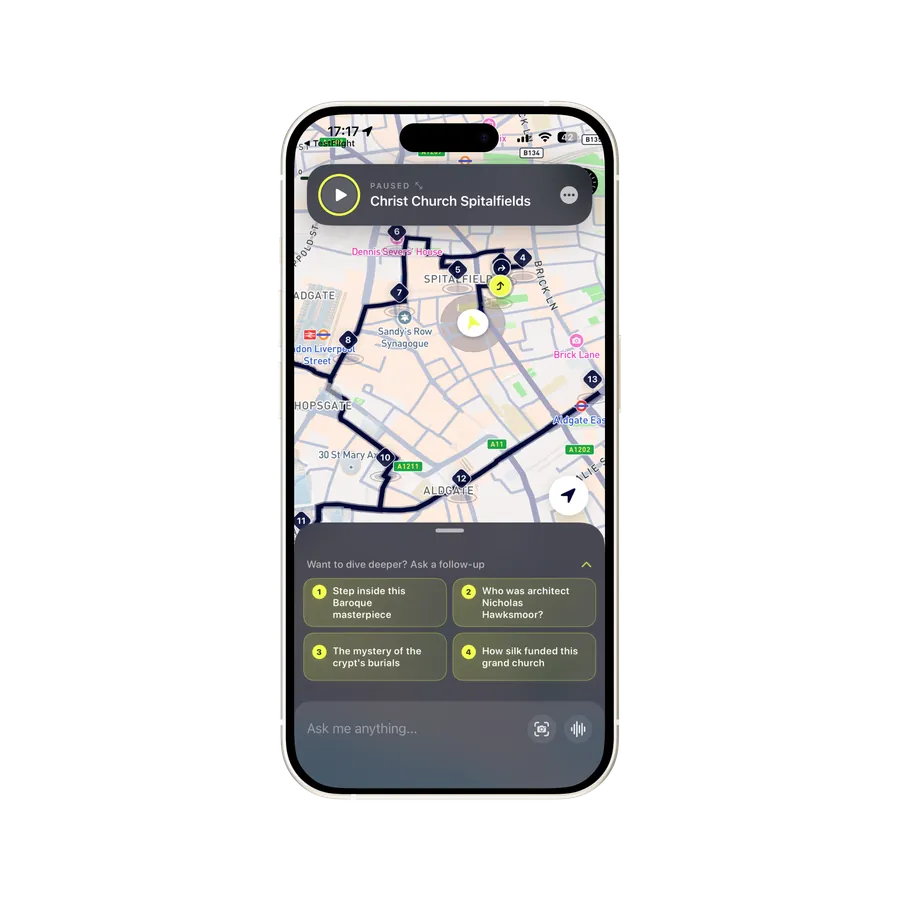
Any street, theme or vibe. "Piazza buskers", "Royal Opera House", "Seven Dials shopping", "Neal's Yard at 09:30", "Drury Lane Garrick". iWander writes you the walk in 30 seconds.

iWander audio walk in progress

02

Hear the story as you walk.

The 1631 piazza, the medieval fruit-and-veg market, Boswell meeting Johnson at 27 Russell Street, Dickens haunting the Theatre Royal, the 1830 Market Building, the 1974 market move to Nine Elms, the 1980 tourist redevelopment, today's buskers.

iWander on-demand AI guide

03

Ask anything along the way.

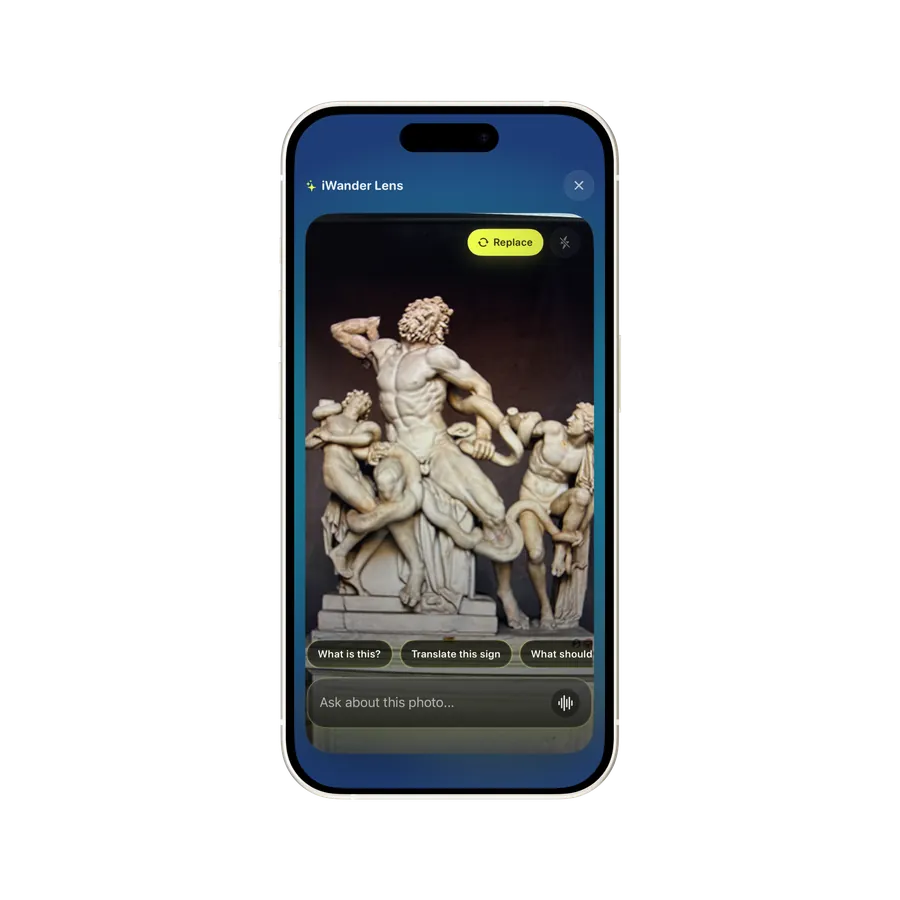
Whose plaque? Which theatre? When did that close? Point your camera, ask out loud, or type. Your guide answers in seconds.

Works offline · 9 voiced languages · 30 free minutes on signup

What makes it worth walking

The first piazza in England, four centuries of selling things, the second-most-photographed square in London

Covent Garden is the closest London ever got to copying Italy. In 1630 the Earl of Bedford was given permission by Charles I to redevelop his former monastic land - the "convent garden" of Westminster Abbey, which had been confiscated by Henry VIII a century earlier - into a residential square in the new Italian fashion. Bedford hired Inigo Jones, the architect who had brought Palladian classicism to England a decade earlier with the Banqueting House at Whitehall. Jones designed a single large open square framed by uniform terraced houses with continuous arcaded fronts - the first such Italian piazza in England, finished in 1631. It became the prototype for every London garden square that followed: Bloomsbury, Belgravia, Eaton Square, the lot.

The market arrives

The piazza was aristocratic for about 30 years. By 1660 fruit-and-vegetable vendors had begun setting up stalls on the south side of the square - originally informally, then by royal charter from Charles II in 1670, giving the Earl of Bedford the right to operate a market. The aristocrats moved out (to Mayfair, mostly); the market took over. By the 1830s the informal stalls had grown into a chaos of carts, sheds and temporary structures choking the whole square. Charles Fowler designed the formal Market Building in 1830 - the long iron-and-glass-roofed pavilion you see today, still in use though now full of shops and cafés rather than fruit.

The market grew. By 1900 Covent Garden was the largest fruit-and-vegetable market in Britain, supplying the whole of London. The streets around the piazza became congested with porters carrying barrels, carts unloading, hawkers, public houses serving market workers from 04:00 onwards. The wider neighbourhood developed around this trade: the Lamb & Flag pub (oldest in Covent Garden, licensed 1772), the surrounding theatreland that drew patrons from the visiting market traders, the Theatre Royal Drury Lane (the licence is 1663, making it the oldest continuously-operating theatre in the English-speaking world). Covent Garden was a working-class quarter dressed up around aristocratic architecture.

The 1974 move and the rescue

The market had outgrown the site by mid-20th century. Traffic congestion, refrigeration needs, the increasing size of distribution lorries - none of it could be accommodated in a 17th-century piazza. In November 1974 the wholesale fruit-and-vegetable market moved out to a new purpose-built site at New Covent Garden in Nine Elms, south of the river. The piazza was suddenly empty.

The plan was demolition. The Greater London Council in 1974 announced that Covent Garden would be redeveloped as a road interchange and modern office complex - the same fate that the wider central-London 1960s and 70s planners had earmarked for Soho and Whitechapel. A campaign by local residents, businesses and conservationists (the Covent Garden Community Association, founded 1971, still operating) fought the redevelopment through public inquiries for two years. The campaign won. In 1976 the listed buildings were saved; the piazza was redeveloped as a pedestrianised market for tourists rather than wholesale; the 1830 Market Building was restored. The first new market reopened in 1980. The Apple Market crafts came shortly after.

The Royal Opera House and the theatres

The Royal Opera House on the north-east corner of the piazza has had three buildings on the same site: the first (1732) burned down, the second (1809) also burned down, the third (1858) survives. A major 1999 redevelopment opened up the public spaces - the Paul Hamlyn Hall amphitheatre bar (originally the Floral Hall, then the market's flower hall), the Linbury Theatre underground, the public terraces overlooking the piazza. The Royal Ballet and the Royal Opera both perform here; programming is among the most ambitious in Europe. The standing-room tickets at £4-8 are one of London's great cultural bargains.

The wider Theatreland extends south from the piazza: Drury Lane (1663, the oldest), the Lyceum (1834, currently hosting The Lion King), the Aldwych (1905), the Adelphi (1806), the Vaudeville (1870), the Duchess (1929). About 40 theatres operate in the West End, most clustered between Covent Garden and Soho. The TKTS half-price ticket booth on Leicester Square - five minutes south of the piazza - sells genuine same-day discounted tickets.

Seven Dials, Neal's Yard, the surrounding streets

The piazza is the centre but the surrounding streets carry the better walking. Seven Dials - a small star intersection where seven streets meet - was built in 1693 by Thomas Neale, the same speculator who built much of the wider area. The sundial column in the centre (the original 1693 column was demolished in 1773 on the suspicion it was a Catholic gathering point; the current column is a 1989 replica). The seven streets around it - Earlham, Mercer, Monmouth, Short's Gardens, plus three smaller - host independent fashion, restaurants and cafés on a more human scale than the Piazza itself. Neal's Yard - the small colourful courtyard accessed through narrow alleys off Short's Gardens - is named for the same Thomas Neale; it has been a cluster of small shops since the 1970s and home to Neal's Yard Remedies (the natural cosmetics company) since 1981. Monmouth Coffee Company opened nearby in 1978 and became one of the early UK speciality-coffee leaders.

The London Transport Museum on the south-east corner of the piazza (the 1872 Flower Market building, restored) is one of the best small museums in London - the original Metropolitan Line carriages, the first Routemaster bus, Harry Beck's original 1933 tube map. It's a real museum with serious historical depth, not a tourist gift shop. Entry is £25.50 but the ticket is valid for a full year, which makes it good value for residents and returning visitors.

Questions

Frequently asked

Covent Garden is the West End piazza and surrounding district just east of Soho - originally laid out as London's first 'square' in 1631 by Inigo Jones, modelled on the Italian Renaissance piazza. The covered Market Building dates from 1830. The market itself moved out in 1974 to Nine Elms. The Piazza was then redeveloped into a tourist district: shops, cafés, street performers in the cobbled square, the Apple Market for crafts, the East Colonnade for design.
A full Covent Garden walk - the Piazza, the Royal Opera House exterior, Theatre Royal Drury Lane, Seven Dials, Neal's Yard, the London Transport Museum, Floral Street to Long Acre - is 1.5 to 2 hours at a relaxed pace. A focused walk (just the Piazza and Market, or just Seven Dials and Neal's Yard, or just the theatre history walk) is 45-60 minutes.
Yes, even if you don't see a show. The 1858 building (the third opera house on this site) had a major 1990s extension that opened up the public spaces - the Paul Hamlyn Hall amphitheatre bar and the Linbury Theatre are both free to enter during opening hours (10:00-22:00 most days). The terrace overlooks the Piazza. The 1858 main auditorium can be visited on a 1-hour tour (about £21, several daily). Tickets for performances start at £4 (standing room).
A small star-shaped intersection where seven streets meet at a central monument with a sundial column (built 1693, restored 1989). Originally a 1690s aristocratic development that decayed into a 19th-century slum (Dickens described it in Sketches by Boz) and is today a small but excellent shopping and food district - independent fashion, cafés, restaurants. Neal's Yard - the small colourful courtyard a block north on Short's Gardens - is the most-photographed corner.
A small triangular courtyard accessed through narrow alleys off Short's Gardens and Monmouth Street, painted in the brightest yellows, pinks and blues in central London. Neal's Yard Remedies (the natural cosmetics brand) was founded here in 1981. The yard has a vegetarian café, a bakery, a couple of cocktail bars, and the original Monmouth Coffee Company shop two blocks south. The yard is tiny (about 30 metres across) and photogenic; busy on weekends, calm Monday-Wednesday.
On the south-east corner of the Piazza, opposite the Royal Opera House. A museum dedicated to the history of London's transport - the tube, buses, trams, taxis, and the road network. The collection includes original Victorian Metropolitan Line carriages, the first Routemaster bus, the original tube map by Harry Beck, and the cab driver's Knowledge maps. £25.50 adult; ticket valid for a year. Open daily 10:00-18:00.
Yes - the Covent Garden street-performance pitch has been licensed since 1980 and runs every day (weather permitting) on the West Piazza, in front of St Paul's Church and around the Market Building. Performers are vetted by the Covent Garden Area Trust; you'll see escapologists, opera buskers (the church accommodates the better-known operatic acts), magicians, juggling on unicycles. Performances run 10:00-21:00 in summer. Free to watch; tipping is expected.
Tube: Covent Garden (Piccadilly Line) is the obvious entry - drop you exactly at the Piazza but is one of London's busiest stations and exits via lift; some long queues. Better: walk from Leicester Square (Northern, Piccadilly) - 4 minutes east; or Charing Cross (Northern, Bakerloo) - 6 minutes north; or Tottenham Court Road (Elizabeth, Central, Northern) - 7 minutes south.

How to find it

Getting to Covent Garden

Postcodes
WC2E, WC2H (West End, central London)
Nearest tube
Covent Garden (Piccadilly), Leicester Sq (Piccadilly, Northern), Charing Cross (Northern, Bakerloo), Tottenham Court Road (Elizabeth, Central, Northern)
From Heathrow
Elizabeth Line to Tottenham Court Rd, 7-min walk south (45 min) · about £12
From Gatwick
Gatwick Express to Victoria then Piccadilly Line east (50 min) · about £25
Best season
Year-round. Theatres run continuously; the Piazza Christmas tree (late Nov-Jan) is the busiest moment
When to walk
Piazza buskers 12:00-20:00. Royal Opera House standing tickets at the door 90 min pre-curtain. Neal's Yard Mon-Wed before 11:00

The headline sights

Three landmarks to anchor your walk

Pull the audio walk around any of these and the rest of Covent Garden falls into place.

The Piazza + Market Building

Inigo Jones's 1631 Italian-style square - the first piazza in England. The 1830 iron-and-glass Market Building is the centrepiece, now full of shops and cafés. The Apple Market crafts in the East Colonnade. Buskers in the cobbled West Piazza. Free, open all the time.

Walk the Piazza

Royal Opera House

NE corner of the Piazza. 1858 building (the third on the site), 1999 extension. Paul Hamlyn Hall and the public terraces are free to enter daily 10:00-22:00. Standing tickets for performances £4-8. Daily backstage tours £21.

Walk the Opera House

Seven Dials + Neal's Yard

A 3-minute walk north-west of the Piazza. Star intersection of seven streets meeting at a 1989 sundial column. Independent fashion, cafés, restaurants. Neal's Yard - the colourful triangular courtyard - is one block north of Seven Dials on Short's Gardens.

Walk Seven Dials

Other London neighbourhoods to wander

Walk somewhere else in London

Build any Covent Garden walk you want.

Tell us a theme, a question, a vibe - the 1631 piazza, Royal Opera House standing tickets, Seven Dials shopping, Neal's Yard at 09:30, a Drury Lane history walk - and your walk is ready in 30 seconds.

Get the iWander app

30 free minutes on signup · Subscriptions from $10/mo · Cancel anytime

Updated 19 May 2026 by the iWander local team · Curated for accuracy