AboutEnterprise solutionsGet the app
Free walking tour · Soho · London

Walk Soho,
your way.

Free Soho walking tour - Old Compton, Carnaby, Chinatown, Ronnie Scott's, in 30 seconds

Your free walking tour of the densest square mile in London - food, sex, jazz, theatre, advertising, vinyl, Chinese New Year, gay liberation, all in twelve minutes' walk. Pick a walk below or tell us a theme. Works offline, 9 voiced languages, 30 free minutes on signup.

Or pick your walk

Local knowledge

What we'd tell you on day one

Six things that change how you walk Soho.

01

Soho is small. Walk it.

The whole square - bordered by Oxford Street north, Regent Street west, Leicester Square south and Charing Cross Road east - is about 12 minutes' walk corner-to-corner. Don't take the tube within Soho. Tottenham Court Road tube on the east, Piccadilly Circus on the west, Oxford Circus on the north and Leicester Square on the south are the four entry stations - pick one and walk in. The Elizabeth Line opening at Tottenham Court Road in 2022 made the east end the busiest entry.

02

The half-price ticket booth is real.

The TKTS booth on Leicester Square (south side of the Square in a clearly marked island building) sells genuinely-discounted theatre tickets on the day of performance - typically 30-50 percent off face value, with no booking fee. Open Monday-Saturday 10:00-19:00, Sunday 11:00-16:30. The catch: it's same-day only, you can't choose your seats from a chart (they offer you what's available), and the biggest hits (Hamilton, the longest-running productions) rarely appear. For a midweek matinee of a major play it's the cheapest legitimate way to get a West End seat.

03

Chinatown is best on Sunday.

Dim sum tradition: Sunday late morning, the restaurants on Gerrard Street and Wardour Street (Dumplings' Legend, Bao, Plum Valley, Royal China) fill from 11:30 onwards. By 13:00 most have a queue; by 14:30 the queue is gone but the dim sum carts have stopped. Best to arrive 11:30-12:00. The dragons over Gerrard Street and the four red paifang gates (added 1985-2016) make the photogenic walk. Lunar New Year (typically late January-mid February) sees the biggest celebration outside Asia.

04

Ronnie Scott's needs the second set.

The first set (typically 20:30) is the headline programme; the second set (22:30 or 23:00) is often a different ensemble, sometimes a workshop slot, always cheaper, and almost always more atmospheric. The second set crowd is jazz musicians, students, drunk admirers - a different room. Tickets £30-50; book online, dress jacket (no dress code formally but the room expects effort), arrive by the start of the second set for the seat.

05

Pre-theatre dinner is a Soho speciality.

If you're going to a 19:30 show, your dinner window is 17:00-18:30. Most West End theatres have a 7:30 curtain. Soho's pre-theatre menus run during this window - typically a 2-course set menu at 30-40 percent off the à la carte price. Quo Vadis, Bocca di Lupo, Côte, Andrew Edmunds, Hawksmoor all do it. Book ahead but mention pre-theatre and a 6pm reservation usually opens up. After the show, Soho stays open till 02:00; the Coach & Horses (Greek Street) is the after-show pub.

06

Carnaby is touristy. Kingly Court is real.

Carnaby Street itself is now mostly mid-market high-street brands (Diesel, Levi's, Pepe Jeans, Vans, etc.) - fine for a quick walk, not exciting. Kingly Court - the three-storey courtyard off Carnaby through a narrow gateway - is where the real food and small-shop interest sits: Whyte & Brown for chicken, Pizza Pilgrims, Le Bab, Burger and Lobster, Imperial Bar. Liberty London's Tudor-revival building (Great Marlborough Street side) is 30 seconds away and free to walk into; it's still the best department store in London and the Tudor-style interior is worth seeing.

How it works

How iWander walks Soho with you.

Three things, in 30 seconds.

iWander home screen

01

Type your walk.

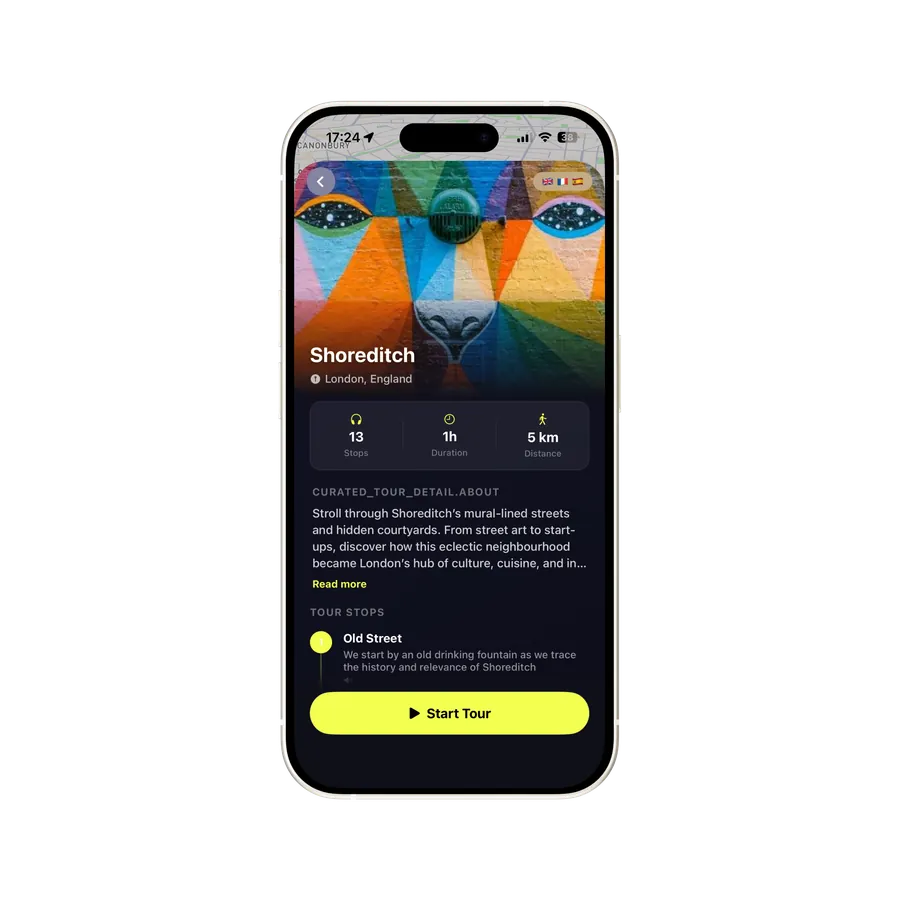
Any street, theme or vibe. "Chinatown dim sum", "Old Compton at 22:00", "Ronnie Scott's", "Carnaby 1965", "Berwick Street market". iWander writes you the walk in 30 seconds.

iWander audio walk in progress

02

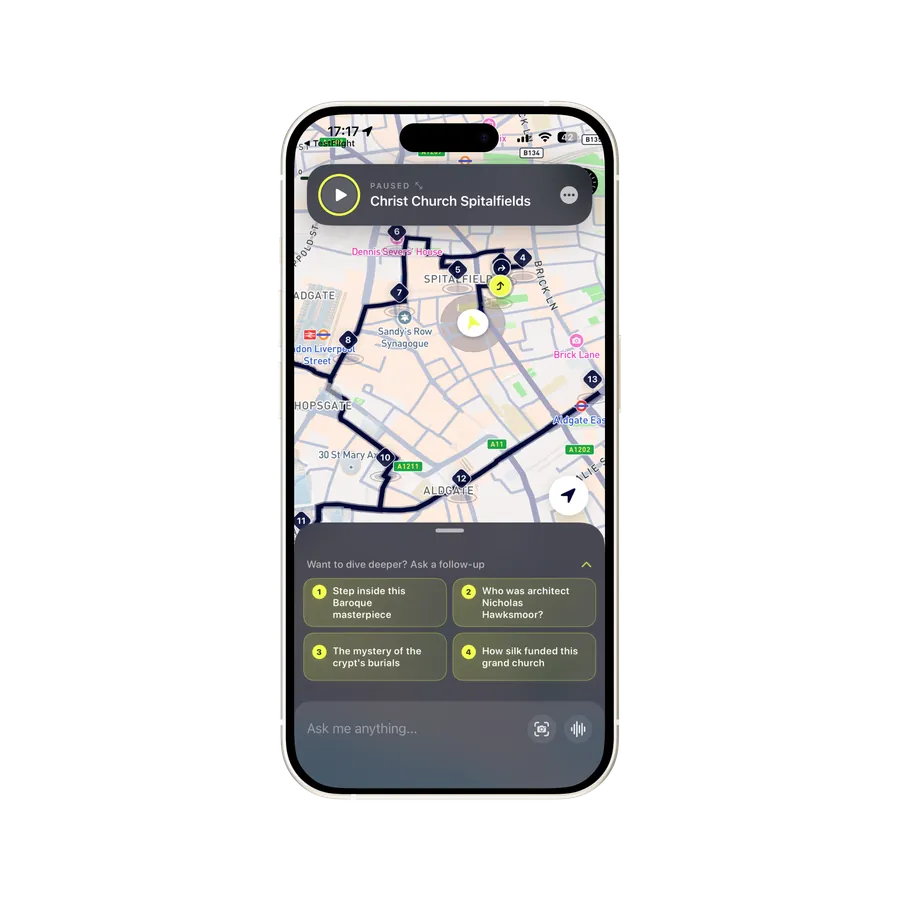
Hear the story as you walk.

The 17th-century hunting cry, the Huguenot refugees, Karl Marx's Dean Street years, the Soho Square Sunday writers, the 1960s music boom, the gay liberation of the 1980s, the AIDS years, the 1999 Admiral Duncan attack, the 2010s gentrification, today's Soho.

iWander on-demand AI guide

03

Ask anything along the way.

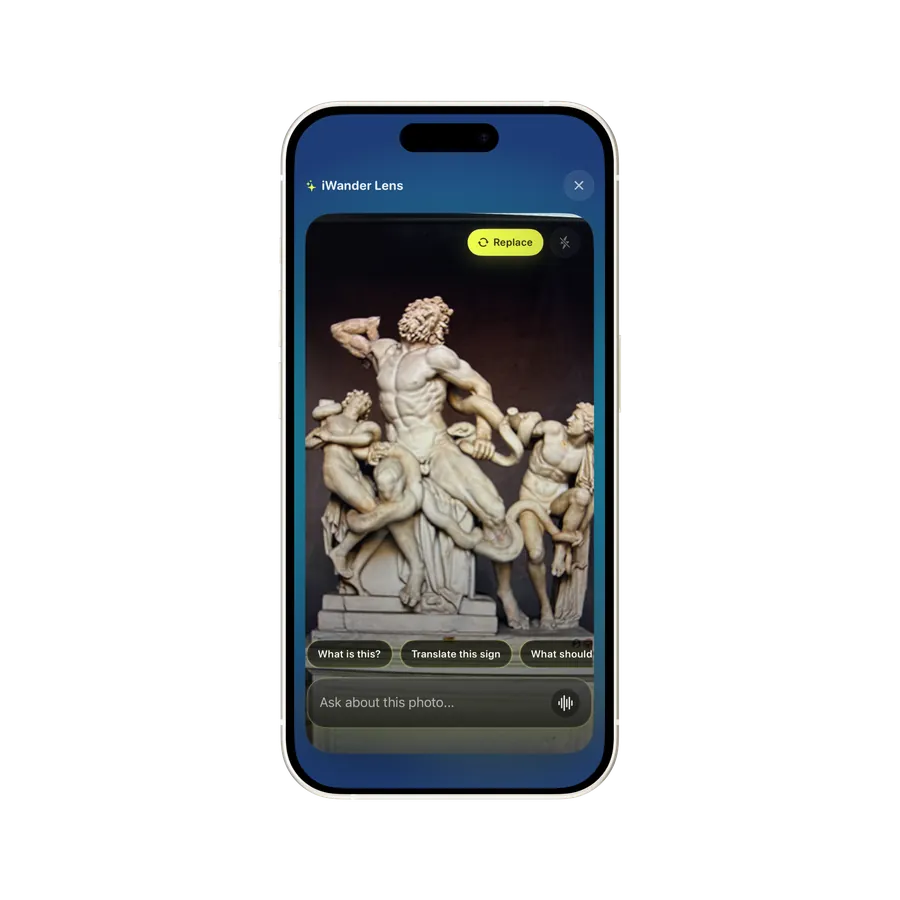
Whose blue plaque? Which restaurant? When did that close? Point your camera, ask out loud, or type. Your guide answers in seconds.

Works offline · 9 voiced languages · 30 free minutes on signup

What makes it worth walking

The square mile that has been London's elsewhere for 400 years

Soho is the part of London where the city does the things it would rather not do in front of itself. For four centuries the place has been an immigrant arrival quarter, a dirty-business district, an entertainment zone and a hideout for people who didn't fit anywhere else. The geography matters - Soho is the only piece of central London that wasn't laid out by an aristocrat, and the 17th-century pattern of narrow east-west streets and tight blocks has stayed since 1670. Today the square mile holds about 4,000 residents, 700 food businesses and 35 working music venues - the densest concentration of restaurants and bars in the UK by some distance.

From hunting field to immigrant quarter

The name "Soho" comes from a 17th-century hunting cry - English hunters chasing rabbits across the open fields north of Piccadilly shouted "So! Ho!" The fields were turned over to building from the 1660s after the Great Fire, when the population pressed outwards from the City. Soho Square was laid out in 1681 as a grand garden square with a statue of Charles II (still there) in the centre. The square was meant to be an aristocratic address but the aristocracy preferred Mayfair, and Soho got the working-class and immigrant overflow instead.

The first big wave was the Huguenots - French Protestants fleeing religious persecution after Louis XIV revoked the Edict of Nantes in 1685. About 50,000 Huguenots settled in London in the late 17th and early 18th centuries; many of them in Soho, where they worked as silversmiths, watchmakers, weavers and printers. The French Protestant Church (still standing at 8 Soho Square, the building rebuilt in 1893) became their centre. The names of the Huguenot trades - silver, silk, glass - are still on the older shop fronts. Karl Marx wrote much of Das Kapital while living at 28 Dean Street in the 1850s. Mozart, age 8, lived at 20 Frith Street in 1764-65 and gave concerts at the family's lodgings.

Theatre, music halls, jazz

By 1850 Soho was London's entertainment district. The first English theatre to be lit by gas was the Royalty on Dean Street (1817, gone). The first music hall - the Trocadero - opened on Great Windmill Street in 1840 (gone, the site is now Trocadero Centre). The Café Royal on Regent Street (still standing, now a hotel) was where Oscar Wilde, Aubrey Beardsley and the Aesthetic Movement met from the 1880s. The early-20th-century private clubs - the Colony Room at 41 Dean Street, the Gargoyle on Meard Street, the Coach and Horses on Greek Street - hosted Francis Bacon, Lucian Freud and the wartime Soho bohemians.

The post-war jazz scene was born in Soho cellars. Ronnie Scott opened his first club at 39 Gerrard Street in 1959; it moved to 47 Frith Street in 1965 (where it still operates). Pizza Express Jazz Club opened in the basement at 10 Dean Street in 1969 and has been running nightly shows ever since. The 100 Club on Oxford Street (technically the south edge of Fitzrovia but functionally Soho) opened in 1942 and hosted everyone from Louis Armstrong to the Sex Pistols' 1976 Punk Festival.

Chinatown moves in, gay Soho emerges

London's Chinese community was originally in Limehouse, the East End docklands quarter where Chinese sailors had settled from the 1860s. The Limehouse Chinatown was destroyed in the WWII Blitz; the displaced community moved to Soho through the 1950s and 1960s, attracted by cheap rent and existing Cantonese restaurants. Gerrard Street, originally a Huguenot textile street, became the spine of the new Chinatown. The pedestrianisation came in 1985; the first paifang gate (the south gate on Wardour Street) followed in the 1990s; the second, third and fourth gates were added through the 2000s and 2010s, culminating in the 2016 north gate on Wardour Street. Today Chinatown has about 80 restaurants - mostly Cantonese, with growing Sichuan, Hunan, Korean and Japanese representation - plus the city's main Asian supermarkets.

Gay Soho - the village along Old Compton Street - emerged in the late 1980s. The Admiral Duncan pub (54 Old Compton Street) became one of the first openly gay pubs in the 1980s; it was attacked on 30 April 1999 by a neo-Nazi who detonated a nail bomb, killing three people and injuring 70. The community rebuilt within months; the pub reopened later that year and has been running since. The wider Old Compton Street strip has expanded west and north over the decades; G-A-Y Bar moved to its current Old Compton location in 2008. Pride London ends with a rally in Trafalgar Square but the after-celebration moves to Soho.

The 2010s gentrification, the post-Covid Soho

Rent rises through the 2010s pushed out many of the smaller, older Soho institutions - the iconic Madame JoJo's drag bar closed in 2014, the original Astoria music venue was demolished in 2009 for Crossrail, dozens of small record shops and second-hand bookshops closed. The Covid-19 lockdowns of 2020-2021 hit Soho's food and nightlife economy harder than anywhere else in the country - estimates suggest 40 percent of the area's hospitality businesses closed during the pandemic. The recovery has been uneven: high-end restaurants and cocktail bars have rebounded; small independent music venues have not. Soho House, the members' club that started on Greek Street in 1995, has become a global brand worth billions; the working-class Soho it grew out of is mostly gone.

What remains, though, is the geography. The grid of 17th-century streets, the human-scale buildings, the absence of any single dominant institution, the layered identity that lets a member's club, a Cantonese restaurant, a jazz cellar and a sex shop all coexist on the same block. The neighbourhood the Huguenots and the Marx household and the post-war painters and the punk bands and the gay pioneers all chose because the rest of London couldn't quite swallow them - that Soho is still recognisably itself. Walk it in 2026 and you'll see the layers stacked.
Questions

Frequently asked

Soho is the roughly one-square-mile West End district of central London bordered by Oxford Street (north), Regent Street (west), Leicester Square (south) and Charing Cross Road (east). It is the densest concentration of food, nightlife, theatre and media in the UK - about 700 restaurants and bars, 35+ jazz and music venues, 40+ theatres on its southern edge, the offices of the British advertising and post-production industry, and the historic centres of gay London and London's Chinese community. The name comes from a 17th-century hunting cry.
A full Soho walk - Old Compton Street, Chinatown, Berwick Street market, Carnaby Street, Soho Square, the jazz cellars on Frith and Greek Street - takes 2 to 2.5 hours at a relaxed pace including a coffee stop. A focused walk (just Chinatown, or just the gay village, or just the food crawl) is 45-75 minutes. The whole neighbourhood is one square mile and flat; you can cross it in 12 minutes on foot.
Old Compton Street is the spine - from Charing Cross Road in the east to Wardour Street in the west, about 400 metres. The historic gay village from the late 1980s, anchored by the Admiral Duncan pub (#54, the 1999 nail-bomb attack site, rebuilt and reopened), G-A-Y Bar on Old Compton Street itself, Comptons, the Friendly Society. The neighbourhood lost many venues to rent rises and Covid-19 closures but remains visibly the city's LGBTQ+ heart. Pride London ends in Soho every July.
London's Chinatown sits in the south-west corner of Soho - Gerrard Street is the pedestrianised spine, framed by the four large paifang gates added in the 1980s. It moved here from East London in the 1950s and 1960s after the Limehouse Chinatown was bombed in WWII. About 80 restaurants, 30 bakeries and dumpling counters, and the city's main Asian supermarkets (SeeWoo, Loon Fung). Chinese New Year (late January or February) sees the biggest celebration outside Asia.
Yes - the most famous jazz club in Europe still runs nightly shows at 47 Frith Street, the same address it has had since 1967 (when it moved from the smaller original location on Gerrard Street). Two sets nightly, plus late shows on Fridays and Saturdays. Tickets £30-60 typically; book ahead for the second set. The room is small, the acoustics are extraordinary, the bookings range from Ravi Coltrane to up-and-coming British jazz.
Berwick Street, off Wardour Street, has hosted a fruit-and-vegetable market since 1778 - making it one of the oldest in London. Today the market is much smaller than its peak (down from 100+ stalls in the 1950s to about 15-20 today) but it still operates weekday mornings (typically 09:00-15:00). The street itself remains a music-and-vinyl mecca: Sister Ray, Reckless Records, Sounds of the Universe. The Oasis album cover for '(What's the Story) Morning Glory?' was shot here in 1995.
Tube: Tottenham Court Road (Central, Northern, Elizabeth) for the east; Leicester Square (Northern, Piccadilly) for the south; Piccadilly Circus (Piccadilly, Bakerloo) for the south-west; Oxford Circus (Central, Victoria, Bakerloo) for the north-west. From Heathrow take the Elizabeth Line direct to Tottenham Court Road (40 min). From Gatwick the Gatwick Express to Victoria then Piccadilly Line east (50 min).
Yes. Download a walk over Wi-Fi at your hotel before you head out. UK SIMs are cheap and 5G coverage is excellent across central London. iWander runs entirely on-device once downloaded.

How to find it

Getting to Soho

Postcodes
W1D, W1F, W1B, WC2H (West End, central London)
Nearest tube
Tottenham Court Road (Elizabeth, Central, Northern), Leicester Sq (Piccadilly, Northern), Piccadilly Circus (Piccadilly, Bakerloo), Oxford Circus (Central, Victoria, Bakerloo)
From Heathrow
Elizabeth Line direct to Tottenham Court Road (40 min) · about £12
From Gatwick
Gatwick Express to Victoria then Piccadilly Line east (50 min) · about £25
Best season
Year-round. Theatres run continuously; Soho works in rain. Late Nov-Dec has Christmas lights on Carnaby
When to walk
Berwick Mkt 11:00 weekday. Chinatown dim sum Sun 11:30. Old Compton 22:00 Fri-Sat. Ronnie Scott's second set

The headline sights

Three landmarks to anchor your walk

Pull the audio walk around any of these and the rest of Soho falls into place.

Old Compton Street + Frith

The 400-metre east-west spine of central Soho. Old Compton runs from Charing Cross Road to Wardour Street. The Admiral Duncan, G-A-Y Bar, Patisserie Valerie (the older shop), Bar Italia (the 24-hour coffee). Frith Street crosses it - Ronnie Scott's (#47), Bar Italia (#22, since 1949).

Walk the spine

Carnaby Street + Liberty

The 1960s' "Swinging London" address. Today mostly mid-market chains, but Kingly Court (the three-storey courtyard) is full of good food. Liberty London at the north end (Great Marlborough Street side, 1875 Tudor revival, free to walk in) is the city's most beautiful department store.

Walk Carnaby

Chinatown (Gerrard Street)

Gerrard Street, the 400-metre pedestrianised spine. Four paifang gates (added 1985-2016). About 80 restaurants, 30 bakeries and dumpling counters. The city's main Asian supermarkets one block south (SeeWoo, Loon Fung). Lunar New Year is the biggest celebration outside Asia.

Walk Chinatown

Other London neighbourhoods to wander

Walk somewhere else in London

Build any Soho walk you want.

Tell us a theme, a question, a vibe - Chinatown dim sum, Old Compton at 22:00, Ronnie Scott's, Carnaby in 1965, Berwick Street records - and your walk is ready in 30 seconds.

Get the iWander app

30 free minutes on signup · Subscriptions from $10/mo · Cancel anytime

Updated 19 May 2026 by the iWander local team · Curated for accuracy