AboutEnterprise solutionsGet the app
Free walking tour · Mitte · Berlin

Walk Mitte,
your way.

Free Mitte walking tour - Brandenburg Gate, Reichstag, Museum Island, Unter den Linden, in 30 seconds

Your free walking tour of Berlin's historic centre - the 1791 Brandenburg Gate, the Reichstag with Norman Foster's glass dome, UNESCO Museum Island, the 1.4-km Unter den Linden boulevard, Gendarmenmarkt's twin churches, the Holocaust Memorial, the Hackesche Höfe Art Nouveau courtyards, Checkpoint Charlie. Pick a walk below or tell us a theme. Works offline, 9 voiced languages, 30 free minutes on signup.

Or pick your walk

Local knowledge

What we'd tell you on day one

Six things that change how you walk Mitte.

01

Book the Reichstag dome the moment your trip dates lock.

The Reichstag dome (Platz der Republik 1) is one of Berlin's best free experiences - Norman Foster's 1999 glass dome, a spiral ramp to a 360-degree panorama of central Berlin, the parliament chamber visible below your feet. Entry is free but online-booking-only through bundestag.de. Slots release 2-8 weeks ahead and the popular times (sunset, weekends) sell out fast. There is a same-day standby option at the visitor centre west of the Reichstag (08:00-18:00), but the queue can be 2 hours and there's no guarantee. Plan ahead. Open 08:00-24:00 daily, last entry 21:45. Bring a photo ID matching the booking name. The visit takes 45-60 minutes total. Best time: 90 minutes before sunset, so you see the city in daylight, golden hour and darkness in sequence.

02

The Pergamonmuseum is closed until 2037.

The famous Pergamon Altar, Ishtar Gate of Babylon, and Market Gate of Miletus were closed off in October 2023 for a full structural renovation of the Pergamonmuseum building - the closure runs until 2027 at the earliest for one wing, and 2037 for the full reopening. The Pergamon Panorama exhibition (Am Kupfergraben 2, opposite Museum Island - €12-19, daily 10:00-18:00) by Yadegar Asisi is the official substitute - a 360-degree painted panorama of ancient Pergamon, with select original objects from the museum on display alongside. The other four Museum Island museums are fully open: the Neues Museum (Nefertiti, Egyptian collection) is the unmissable one; the Alte Nationalgalerie holds 19th-century painting; the Bode is small but specialist (Byzantine); the Altes (Schinkel's 1830 building) holds classical antiquities. The combined Museum Island ticket €24 is the best value for a day of museum-hopping.

03

Mitte's tourist density is high - walk early or after dark.

The 2.8-km axis from Brandenburg Gate to Alexanderplatz along Unter den Linden carries about 10 million tourist visits a year, with peak density 10:00-17:00 in summer. The same walk before 09:00 or after 20:00 is almost empty - the Brandenburg Gate at sunrise (around 05:00 in June, 08:00 in December) is a different photograph; Museum Island at 21:00 with the museums closed but the buildings illuminated is the calmest experience. Standard museum hours are 10:00-18:00 (closed Mondays); the open-air parts (Brandenburg Gate, Reichstag exterior, Holocaust Memorial, Gendarmenmarkt, Museum Island riverside, the Stadtschloss/Humboldt Forum facade) are 24/7. The Holocaust Memorial after dark (under the discreet lighting) has a particularly strong atmosphere.

04

The Berlin Wall ran through Mitte - look for the cobblestone line.

The Berlin Wall ran north-south through Mitte from 1961 to 1989, splitting the historic district between East and West Berlin. Most of Mitte was in East Berlin; the Wall ran approximately along the modern Ebertstrasse (just east of the Brandenburg Gate), then south through Potsdamer Platz, then along the western edge of Mitte to Checkpoint Charlie and onwards. The line of the Wall is marked through central Berlin by a double row of cobblestones set into the pavement with the inscription "Berliner Mauer 1961-1989" - follow it from Brandenburg Gate south past the Holocaust Memorial, across Potsdamer Platz, to Checkpoint Charlie (about 1.5 km). Other Wall sites worth pairing: the Berlin Wall Memorial at Bernauer Strasse (1.5 km north of Hauptbahnhof - the best dedicated Wall site in Berlin); the Topography of Terror (the former Gestapo headquarters, free, daily 10:00-20:00); the East Side Gallery in Friedrichshain (the 1.3-km painted Wall section).

05

The Hackesche Höfe is the start of the Scheunenviertel Jewish Quarter.

The Hackesche Höfe (Rosenthaler Strasse 40-41) is the most-photographed Mitte courtyard ensemble - 8 Art Nouveau courtyards by August Endell, 1906-1907 - but the surrounding 4-block area is the Scheunenviertel, Berlin's historic Jewish Quarter (from the late 18th century until the Nazi destruction 1938-1942). Walk 200 metres north from Hackesche Höfe to the New Synagogue (Oranienburger Strasse 28-30) - the 1859-1866 Moorish-revival synagogue with the famous golden dome, the largest synagogue in Germany before WWII, now a museum and small functioning congregation (€7, Sun-Fri 10:00-18:00, security check). Continue west on Oranienburger Strasse for the Stolpersteine (brass stumbling-stones in the pavement, each memorialising a Nazi victim deported from that address). The Jewish Cemetery Mitte (Grosse Hamburger Strasse) and the Otto Weidt Workshop for the Blind (Rosenthaler Strasse 39, adjacent to Hackesche Höfe - the workshop where Otto Weidt hid Jewish employees during the Nazi period, free museum, daily 10:00-18:00) are quieter and more affecting than the famous Höfe.

06

Mitte's best eating is one block off the main axis.

The Unter den Linden / Museum Island axis is heavy on tourist-priced cafés and beer-hall chains; the good Mitte eating is one block north (around Hackesche Höfe / Auguststrasse / Tucholskystrasse) or one block south of Friedrichstrasse. Classic Mitte food: Borchardt (Französische Strasse 47 - since 1853, the political schnitzel canteen, reserve ahead, €25 schnitzel); Mogg (Auguststrasse 11 - small Jewish-American deli with the best pastrami in Berlin); Pauly Saal (Auguststrasse 11 - Michelin-star modern German); Standard Serious Pizza (Templiner Strasse 7 - the best pizza in Berlin); Hartmanns (Fichtestrasse 31, Kreuzberg but walkable - Michelin schnitzel); the Curry 36 wurst stand outside Mehringdamm U-Bahn (technically Kreuzberg, but the canonical currywurst). Brunches: Distrikt Coffee (Bergstrasse 68), House of Small Wonder (Johannisstrasse 20). The KaDeWe food hall in Charlottenburg is the city's gourmet supermarket; Markthalle Neun in Kreuzberg (Eisenbahnstrasse 42-43) the foodie market.

How it works

How iWander walks Mitte with you.

Three things, in 30 seconds.

iWander home screen

01

Type your walk.

Any sight, theme or vibe. "Brandenburg Gate to Alexanderplatz axis", "Reichstag dome at sunset", "Museum Island in 3 hours", "Cold War Mitte - Wall, Checkpoint Charlie, Topography of Terror", "Hackesche Höfe and the Scheunenviertel Jewish Quarter", "Bebelplatz book burning + the Neue Wache + the Humboldt Forum". iWander writes you the walk in 30 seconds.

iWander audio walk in progress

02

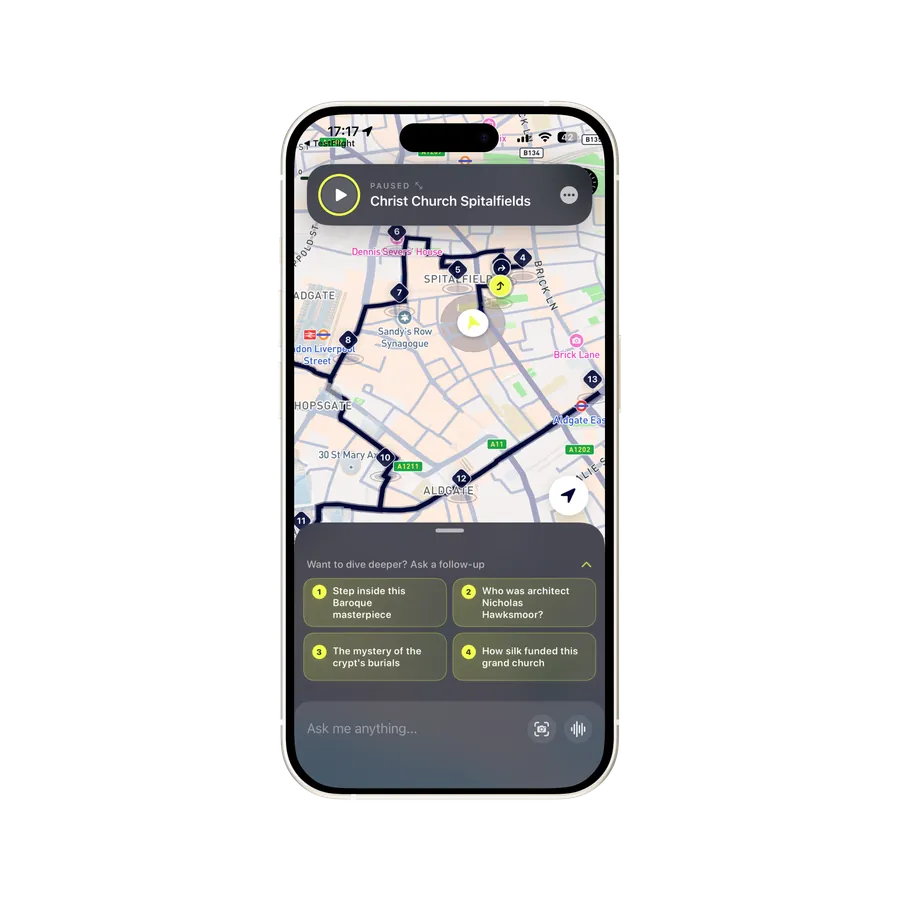
Hear the story as you walk.

The 1647 Great Elector laying out Unter den Linden, the 1788-1791 construction of the Brandenburg Gate, Napoleon taking the Quadriga in 1806, the 1830-1930 building of Museum Island, the 1933 Reichstag fire and the Nazi seizure of power, the 1938 Kristallnacht in the Scheunenviertel, the 1942-44 Holocaust deportations from the Jewish Quarter, the 1945 ruined centre, the 1961 erection of the Wall through Mitte, the 1989 fall, the 1990s reconstruction. 350 years of capital-city history in your headphones.

iWander on-demand AI guide

03

Ask anything along the way.

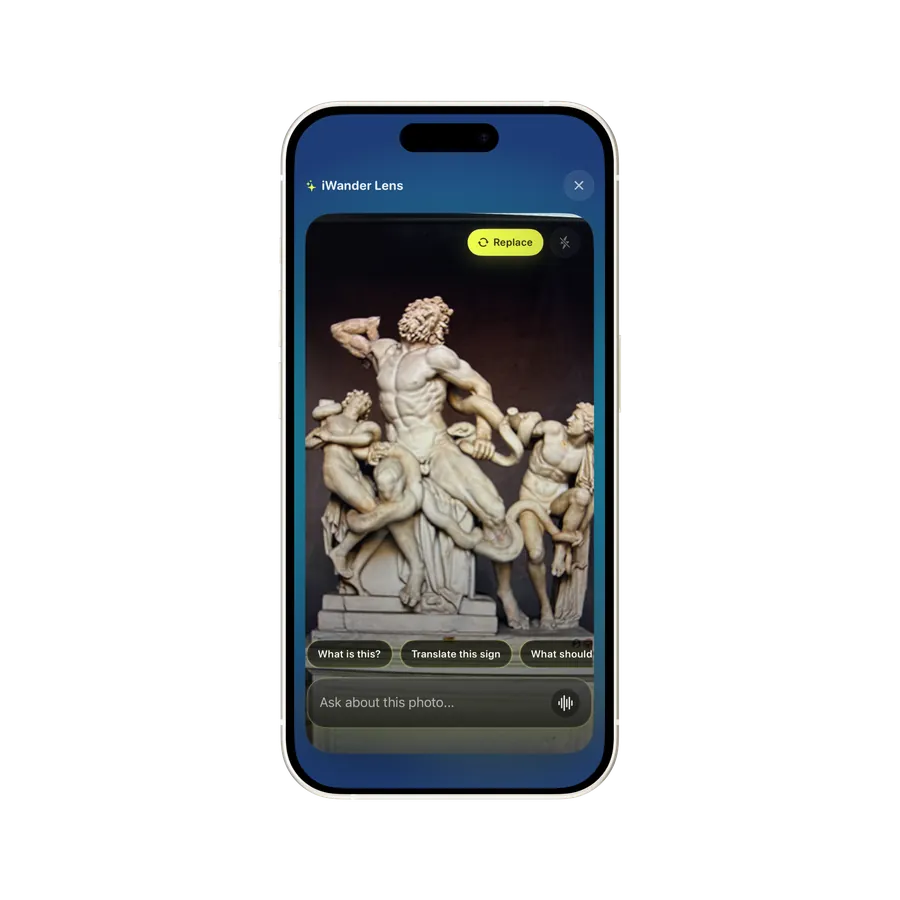
What's a Stolperstein? Why is the Pergamon closed? Where's the line of the Wall? When does the Reichstag dome close? Point your camera, ask out loud, or type. Your guide answers in seconds.

Works offline · 9 voiced languages · 30 free minutes on signup

What makes it worth walking

From 13th-century twin town to imperial capital to divided centre to reunified capital - 800 years on a 2.8-km axis

Mitte is the historic centre of Berlin and the densest concentration of capital-city history in Europe. The district holds Berlin's most-photographed landmarks - the Brandenburg Gate, the Reichstag, Museum Island, Unter den Linden, Gendarmenmarkt - all within a 2.8-km walkable axis from Pariser Platz in the west to Alexanderplatz in the east. Walking Mitte is walking 800 years of German history compressed into a single flat district: the medieval twin towns of Berlin and Cölln, the Prussian capital of Frederick the Great, the imperial capital of Wilhelm I and Bismarck, the Weimar Republic, the Nazi capital, the ruined post-1945 city, the divided Cold War centre with the Wall running through, the reunified capital from 1990. No other European city packs this many epochs into so small a walking distance.

Medieval Berlin and Cölln

Berlin began as twin towns - Berlin (north bank of the Spree) and Cölln (south bank, on the island that is now Museum Island and the Humboldt Forum site) - first documented 1237 (Cölln) and 1244 (Berlin). The two towns merged formally in 1432, became the Brandenburg ducal capital under the Hohenzollern dynasty from 1448, and were progressively expanded and reshaped over the next 400 years. Almost nothing of the medieval city survives - WWII bombing and the post-war demolitions removed most of the older fabric - but the street pattern of the Nikolaiviertel (Berlin's oldest surviving quarter, partially reconstructed in 1987 for Berlin's 750th anniversary) and the orientation of the Marienkirche (the 13th-century Marienkirche, the second-oldest church in Berlin, near Alexanderplatz) preserves the medieval footprint.

Frederick the Great and the Prussian capital

The Prussian transformation of Berlin began with Frederick Wilhelm, the Great Elector of Brandenburg (1640-1688), who laid out the Lustgarten and the early Unter den Linden in 1647. The decisive period was Frederick the Great (Frederick II, 1740-1786) - the Forum Fridericianum project (1740s-1770s) created Bebelplatz with the State Opera (1741-1743), St Hedwig's Catholic Cathedral (1747-1773), the Old Library (1775-1780, the curved "Kommode" building), Prince Heinrich's Palace (1748-1753, now Humboldt University main building). The new buildings turned Unter den Linden from a hunting path into a ceremonial axis terminating at the City Palace.

The early-19th-century Schinkel period extended the axis. Karl Friedrich Schinkel (1781-1841) - the most important Prussian neoclassical architect - built the Neue Wache (1816-1818, the royal guardhouse, now Germany's central memorial to victims of war and tyranny), the Schauspielhaus (1818-1821, now Konzerthaus on Gendarmenmarkt), and the Altes Museum (1825-1830, the first museum building on what became Museum Island). The Schinkel buildings define the visual character of central Mitte - clean lines, classical proportions, restrained ornament.

Museum Island

Museum Island was built progressively over a century (1830-1930) as the Prussian-then-German national museum complex on the northern half of the Spree Island. The five buildings: the Altes Museum (1825-1830, Schinkel - classical antiquities); Neues Museum (1843-1855, Friedrich August Stüler - Egyptian collection, the Nefertiti bust); Alte Nationalgalerie (1867-1876, Stüler - 19th-century painting); Bode-Museum (1898-1904, Ernst von Ihne - Byzantine art); Pergamonmuseum (1910-1930, Alfred Messel and Ludwig Hoffmann - the Pergamon Altar, Ishtar Gate, Market Gate of Miletus). Museum Island was added to UNESCO World Heritage in 1999. The Pergamonmuseum has been closed for full renovation since October 2023; the closure runs to 2037. The other four museums remain open and a Museum Island combined ticket (€24, valid one day) is the best value introduction.

The Humboldt Forum opened December 2020 in the reconstructed Berlin City Palace (Stadtschloss) - the 1443-1894 Hohenzollern palace was severely bombed in WWII and demolished by the East German government in 1950; the Palace of the Republic (East Germany's parliament building) stood on the site 1976-2008; the new building (2013-2020) reconstructs the original baroque façades on three sides and adds a modern east façade. Inside, the Humboldt Forum holds the Ethnological Museum, the Asian Art Museum, and the Berlin Exhibition. Free entry to the building; museum entry €7. The Lustgarten in front and the Berlin Cathedral (1893-1905, the largest Protestant church in Germany, €9 entry) complete the eastern end of the Unter den Linden axis.

The imperial and Weimar periods

The 1871-1918 German Empire transformed Mitte from Prussian to imperial capital. The Reichstag building (1884-1894, Paul Wallot) was the new federal parliament; the Berlin Cathedral (1893-1905) was Wilhelm II's Protestant counter to St Peter's; Friedrichstrasse became the city's modern boulevard with department stores, café-restaurants and theatres; the Hackesche Höfe (1906-1907, August Endell) brought Jugendstil to the Scheunenviertel. The Scheunenviertel itself - the area between Hackescher Markt, Rosenthaler Platz, Auguststrasse and Oranienburger Strasse - was Berlin's Jewish Quarter, with the 1859-1866 New Synagogue (Oranienburger Strasse 28-30) as the architectural anchor.

The Weimar Republic (1918-1933) made Mitte the capital of Europe's most experimental cultural moment - Brecht's theatre, Grosz's painting, Döblin's Berlin Alexanderplatz (1929), the cabaret scene, the political street-fighting between Communists and Nazis. The Reichstag building was the centre of Weimar parliamentary democracy; the suspicious 27 February 1933 Reichstag fire (a single arsonist confessed but Nazi involvement has been long suspected) gave Hitler the pretext to suspend civil liberties, ending the Weimar Republic five weeks after his appointment as chancellor.

Nazi Berlin and WWII destruction

The Nazi period (1933-1945) reorganised Mitte as the capital of the planned "Welthauptstadt Germania" (Albert Speer's never-realised redesign of Berlin as the capital of the Nazi empire). Concrete fragments of the planned axis survive - the Reich Chancellery foundations under the Holocaust Memorial site, the Tempelhof Airport (Kreuzberg), the Olympic Stadium (Charlottenburg). The Nazi destruction of the Scheunenviertel Jewish Quarter began with the 9 November 1938 Kristallnacht (the New Synagogue was set on fire but partially saved by a local police chief who insisted on its heritage protection - the building survived in damaged form), continued with the 1942-1944 deportations from Levetzowstrasse and Grosse Hamburger Strasse, ended with the near-complete elimination of Berlin's pre-war Jewish population. The Stolpersteine (brass stumbling-stones) embedded in Mitte's pavements - more than 8,500 across central Berlin - memorialise individual Holocaust victims at the addresses from which they were deported.

The Allied bombing campaign (1940-1945) and the April-May 1945 Battle of Berlin destroyed about 80% of central Mitte. The Reichstag was burned again in the final days; the Stadtschloss was partially destroyed; Unter den Linden's buildings were ruined; Museum Island took multiple direct hits. The 1945-1990 reconstruction was uneven - East Germany rebuilt the major monuments but demolished much of the surviving fabric to make way for socialist-style mass housing (Alexanderplatz, Karl-Marx-Allee in adjacent Friedrichshain) and propaganda buildings (Palace of the Republic, 1976-1990). Most of historic Mitte was in East Berlin from 1949 to 1990.

The Wall and the divided Mitte

The 13 August 1961 erection of the Berlin Wall ran north-south through Mitte. The Wall followed the line of Bernauer Strasse in the north, then south through Potsdamer Platz, Niederkirchnerstrasse, Zimmerstrasse (Checkpoint Charlie), and onwards. Most of historic Mitte was in East Berlin; the Brandenburg Gate sat in the no-man's-land "death strip" between the two Walls, closed to all civilian traffic from 1961 to 22 December 1989. Checkpoint Charlie (Friedrichstrasse 43-45) was the Allied (American) crossing - the most famous of the eight border crossings, used by diplomats and military personnel.

The 9 November 1989 fall of the Wall was triggered by an East German government press conference announcement of travel freedom, misinterpreted by Günter Schabowski to mean immediate effect; the crowds gathered at Bornholmer Strasse forced the border guards to open the crossing at 23:30; by midnight Berliners were crossing freely at all the checkpoints, including Checkpoint Charlie and the Brandenburg Gate (which was officially reopened 22 December 1989 in a ceremony with Helmut Kohl and Hans Modrow). The fall is commemorated through Mitte by a double cobblestone line marking the former Wall route, by the Berlin Wall Memorial at Bernauer Strasse (the most-recommended Wall site overall), and by the few preserved Wall segments at Topography of Terror (the former Gestapo headquarters, now a free open-air documentation centre).

The reunified capital

The 1990-2026 reunified capital phase rebuilt Mitte into the symbolic centre of unified Germany. The Reichstag was renovated 1995-1999 by Norman Foster, who added the iconic glass dome; the Bundestag moved from Bonn to Berlin in 1999. The Brandenburg Gate was renovated 2000-2002. Pariser Platz was rebuilt 1994-2005 with the embassies (US, French, British), the Hotel Adlon and the DZ Bank (Frank Gehry). Potsdamer Platz, demolished in WWII and left as empty no-man's-land 1945-1990, was rebuilt 1992-2000 as a corporate-modernist district (Renzo Piano, Helmut Jahn, Hans Kollhoff). The Holocaust Memorial (Peter Eisenman, 2003-2005) was the most-debated of the new monuments - 2,711 concrete steles on 19,000 sq m immediately south of the Brandenburg Gate. The Stadtschloss reconstruction (2013-2020) closed the eastern end of the Unter den Linden axis.

The Mitte of 2026 is busy, expensive, and the dominant tourist district of Berlin. Hotel prices are the highest in the city (Hotel Adlon at Pariser Platz, the standard ceremonial-stay hotel; the Soho House Berlin in the Auguststrasse area; the Hotel de Rome). The shopping is concentrated on Friedrichstrasse (mid-range, mainstream) and the Hackesche Höfe + Mitte boutique area (independent, design-led). The restaurant scene is in transition - the Mitte of the early 2000s was Berlin's restaurant frontier; the contemporary frontier has moved to Kreuzberg, Neukölln and Friedrichshain, but Mitte still holds the best concentration of long-form serious restaurants (Borchardt, Pauly Saal, Mogg).

Walk Mitte east-to-west from Alexanderplatz to Brandenburg Gate (or west-to-east) along Unter den Linden, branch into the Scheunenviertel for the Jewish Quarter, descend to the Spree for Museum Island and the Stadtschloss/Humboldt Forum, divert south for Checkpoint Charlie and Topography of Terror, finish at Pariser Platz with the Brandenburg Gate and the Reichstag dome. The 2.8-km axis takes 4-5 hours of walking plus museum stops. Bring time, comfortable shoes, and a Reichstag booking confirmed weeks in advance.

Questions

Frequently asked

The historic centre of Berlin and the political, ceremonial and cultural heart of the German capital. Mitte holds the Brandenburg Gate, the Reichstag (Bundestag), Museum Island, Unter den Linden, Gendarmenmarkt, the Holocaust Memorial, Checkpoint Charlie, the Hackesche Höfe. It was divided by the Berlin Wall 1961-1989 (most of Mitte was in East Berlin), then reunified and progressively restored.
A focused walk - Brandenburg Gate, Reichstag exterior, Holocaust Memorial, Unter den Linden, Bebelplatz, Gendarmenmarkt, Museum Island, Hackesche Höfe - takes 3 to 4 hours. Add a museum visit (90-120 minutes) and it becomes a full day. The full axis is 2.8 km, flat and walkable.
Pariser Platz. The 1788-1791 Brandenburg Gate by Carl Gotthard Langhans - 26 metres high, 12 Doric columns, the Quadriga (four-horse chariot driven by Victoria) by Schadow on top. Napoleon took the Quadriga to Paris in 1806; the Prussians took it back in 1814. The Gate stood in the Wall no-man's-land 1961-1989; the site of the 1989 reopening. Free to walk through.
Platz der Republik 1. The 1894 Reichstag building (Paul Wallot), seat of the German Bundestag. Norman Foster's 1999 glass dome is the iconic addition - 47 metres high, with a spiral ramp to a 360-degree panorama. Free entry but online-booking-only through bundestag.de, 2-8 weeks ahead. Open 08:00-24:00, last entry 21:45. Bring photo ID.
Museumsinsel - the northern half of an island in the Spree, holding five world-class museums in a UNESCO World Heritage ensemble. Altes (1830), Neues (Nefertiti, Egyptian), Alte Nationalgalerie (19th-century painting), Bode (Byzantine), Pergamonmuseum (closed for renovation until 2037). Combined ticket €24 covers four open museums for a day. Closed Mondays.
Berlin's historic ceremonial boulevard - 1.4 km long, from the Brandenburg Gate to the Stadtschloss (Humboldt Forum). Laid out 1647 by the Great Elector, lined with linden trees. The boulevard passes the Humboldt University, the State Opera, St Hedwig's Cathedral, the Neue Wache, the Old Library, the German History Museum. 350 years of Prussian-then-German political history in 1.4 km.
Cora-Berliner-Strasse 1. The 2003-2005 Memorial to the Murdered Jews of Europe by Peter Eisenman - 2,711 concrete steles of varying heights on 19,000 sq m, immediately south of the Brandenburg Gate. The visitor walks between the steles; the ground undulates, the experience is intentionally disorienting. The underground Information Centre holds the historical exhibition (free, daily 10:00-19:00 summer, closed Mondays). Free 24/7 above ground.
The most architecturally cohesive square in Berlin. Französischer Dom (1701-1705, French Cathedral) + Deutscher Dom (1701-1708, German Cathedral) + Konzerthaus Berlin (1818-1821, Schinkel). Laid out 1700 as the marketplace and parade ground for the Gens d'Armes regiment. The French Dom tower is the best free city viewpoint (€3, 9-19). The Christmas Market in December is one of the most atmospheric in Berlin.
Friedrichstrasse 43-45. The 1961-1990 Allied (American) Cold War crossing through the Berlin Wall - the third checkpoint after Alpha and Bravo. Site of the 1961 Soviet-American tank standoff. Today heavily commercialised (avoid the fake-uniformed actors). Mauermuseum €18.50 - dated but worth visiting for the escape devices. The free Black Box Cold War next door is the better introduction. Berlin Wall Memorial at Bernauer Strasse is the better full Wall site.
Rosenthaler Strasse 40-41. Eight Art Nouveau courtyards built 1906-1907 by August Endell - the largest enclosed courtyard ensemble in Germany. Hof 1 is the most-photographed (the famous ceramic Jugendstil facade in red, yellow and turquoise). The surrounding Scheunenviertel was Berlin's pre-war Jewish Quarter, with the New Synagogue (1859-1866) as the architectural anchor.
S-Bahn: Brandenburger Tor (S1, S2, S25, S26) for the west; Friedrichstrasse for the centre; Hackescher Markt for the Höfe; Alexanderplatz for the east. U-Bahn: U6 north-south along Friedrichstrasse; U5 from Brandenburger Tor through Unter den Linden, Museumsinsel, Alexanderplatz - the easiest single line. From Hauptbahnhof: 12 min walk south to Brandenburg Gate via Tiergarten.

How to find it

Getting to Mitte

District
Mitte (Ortsteil within the wider Mitte borough) · postal codes 10117/10178
S-Bahn
Brandenburger Tor (west) · Friedrichstrasse (centre) · Hackescher Markt (Höfe) · Alexanderplatz (east)
U-Bahn
U5 from Brandenburger Tor → Unter den Linden → Museumsinsel → Alexanderplatz (the Mitte spine, opened Dec 2020) · U6 north-south Friedrichstrasse
From Tegel / Brandenburg airport (BER)
Airport Express (FEX) to Hauptbahnhof (35 min) · then 12 min walk to Brandenburg Gate via Tiergarten
Walking from Hauptbahnhof
12 minutes south to Brandenburg Gate via Tiergarten
Best season
May-September ideal for outdoor walking. April-June and September for moderate crowds. December for the Gendarmenmarkt Christmas Market. November-February cold but cinematic for the indoor museums
When to walk
Brandenburg Gate + Reichstag exterior + Holocaust Memorial 24/7. Reichstag dome 08-24 (book 2-8 weeks ahead bundestag.de). Museum Island Tue-Sun 10-18 (closed Mon). Hackesche Höfe daily 11-22. Open-air axis quieter before 09:00 and after 20:00

The headline sights

Three landmarks to anchor your walk

Pull the audio walk around any of these and the rest of Mitte falls into place.

Brandenburg Gate + Reichstag

Pariser Platz + Platz der Republik. The 1791 Brandenburg Gate with the Quadriga (four-horse chariot of Victoria) and the 1894 Reichstag with Norman Foster's 1999 glass dome - the two anchoring monuments of Berlin's western Mitte, 600 metres apart. The Brandenburg Gate is free 24/7 (the most-photographed monument in Germany); the Reichstag dome is free but requires online booking through bundestag.de 2-8 weeks ahead. The fall of the Wall at the Gate on 22 December 1989 is the canonical Berlin moment.

Walk Brandenburg + Reichstag

Museum Island + Berlin Cathedral

Bodestrasse 1-3. Five world-class museums on a Spree island - Altes, Neues (Nefertiti), Alte Nationalgalerie, Bode, Pergamonmuseum (closed for renovation until 2037). The Berlin Cathedral (1893-1905, the largest Protestant church in Germany) anchors the south end of the island next to the Lustgarten and the Stadtschloss/Humboldt Forum. Combined Museum Island ticket €24 covers the four open museums for one day; the Pergamon Panorama exhibition (€12) is the substitute for the closed Pergamonmuseum.

Walk Museum Island

Unter den Linden + Gendarmenmarkt

Unter den Linden is the 1.4-km ceremonial axis from the Brandenburg Gate to the Stadtschloss, laid out by the Great Elector in 1647 and lined with the Prussian state buildings - Humboldt University, the State Opera, the Neue Wache, the Old Library. One block south, Gendarmenmarkt is Berlin's most architecturally cohesive square - Französischer Dom and Deutscher Dom (the twin 1700s churches) flanking Schinkel's 1821 Konzerthaus. The two together form the Prussian-Berlin core of Mitte.

Walk Unter den Linden + Gendarmenmarkt

Other Berlin neighbourhoods to wander

Walk somewhere else in Berlin

Build any Mitte walk you want.

Tell us a theme, a question, a vibe - the Brandenburg Gate at sunrise, the Reichstag dome at sunset, a Museum Island deep-dive, a Cold War Mitte route, the Scheunenviertel Jewish Quarter, the Gendarmenmarkt twin-cathedrals - and your walk is ready in 30 seconds.

Get the iWander app

30 free minutes on signup · Subscriptions from $10/mo · Cancel anytime

Updated 22 May 2026 by the iWander local team · Curated for accuracy