AboutEnterprise solutionsGet the app
Free walking tour · Champs-Élysées · Paris

Walk the Champs-Élysées,
your way.

Free Champs-Élysées walking tour - Arc de Triomphe, Avenue Montaigne, Concorde, in 30 seconds

Your free walking tour of "the most beautiful avenue in the world" - the 1.9-km imperial axis from Charles de Gaulle to the Concorde, with side trips into Avenue Montaigne luxury, the Grand Palais glass, the Pont Alexandre III, and the Madeleine. Pick a walk below or tell us a theme and your audio tour is ready in 30 seconds. Works offline, 9 voiced languages, 30 free minutes on signup.

Or pick your walk

Local knowledge

What we'd tell you on day one

Six things that change how you walk the avenue.

01

Walk it downhill, west-to-east.

Start at Charles de Gaulle-Étoile métro and the Arc de Triomphe. Walk east-southeast towards the Concorde - the avenue slopes gently downhill (about 25 metres of fall over 1.9 km). The view down to Concorde, the obelisk, the Tuileries and (in the distance) the Louvre is the canonical Paris postcard. Going uphill gives you a great Arc view but tires you out faster.

02

The Arc has a pedestrian tunnel.

Never try to cross the Étoile roundabout on foot - there's a tunnel from the métro exit on the north side to the Arc itself. The Étoile has twelve avenues converging at speed; the official advice has always been "do not attempt". The tunnel is also the entrance to the climb - 284 steps to the top, no lift. The base, with the Tomb of the Unknown Soldier and the eternal flame relit every evening at 18:30, is free.

03

Real luxury is on Montaigne, not the Champs.

The Champs itself is full of chain stores - Zara, H&M, Sephora, Disney, Foot Locker, the Apple flagship, Sephora. Genuine luxury shopping starts when you turn off it. Avenue Montaigne (south of Rond-Point) has Dior, Chanel, Louis Vuitton, Saint Laurent, Valentino in a four-block stretch. Rue du Faubourg Saint-Honoré (north of the Élysée) has Hermès, Goyard, Yves Saint Laurent's couture. Place Vendôme has the jewellers - Cartier, Boucheron, Van Cleef, Chaumet.

04

The Petit Palais is free and almost empty.

Opposite the Grand Palais on Avenue Winston Churchill, the Petit Palais (also built for the 1900 expo) houses the city of Paris's fine arts museum - Courbet, Delacroix, Cézanne, Manet, Rembrandt, a beautiful interior garden, and a café in the colonnade. Permanently free, open Tuesday-Sunday 10:00-18:00 (Friday-Saturday until 20:00 for temporary shows). The best 8th-arrondissement secret.

05

Avoid the Champs cafés.

The cafés right on the Champs - Fouquet's, the Drugstore Publicis, Ladurée Champs - are tourist-priced and famously rude when busy. Coffee €8-10, mediocre. For a proper coffee and pastry: Angelina at Rue de Rivoli (10 minutes south of Concorde) for hot chocolate that is genuinely the best in Paris; Ladurée's original Rue Royale store for macarons; the Madeleine bakeries (Maison Mulot, Stohrer, Pierre Hermé) for proper Paris.

06

Twice a year the sun sets through the Arc.

The Champs is laid out on a perfect east-west axis. Around 8-10 May and 31 July-2 August, the setting sun aligns directly with the Arc de Triomphe and the Place de la Concorde axis - a brief 10-minute window when the sun is framed inside the Arc from the Concorde direction. The "Star at the heart of the Star". Free, magical, and the date the entire Paris Instagram community shows up. The Bastille Day parade (14 July) marches up the avenue from Concorde to Arc; book café tables months ahead.

How it works

How iWander walks the Champs with you.

Three things, in 30 seconds.

iWander home screen

01

Type your walk.

Any avenue, theme or vibe. "Arc to Concorde", "Avenue Montaigne luxury", "Grand Palais", "Concorde at sunset", "Bastille Day parade route". iWander writes you the walk in 30 seconds.

iWander audio walk in progress

02

Hear the story as you walk.

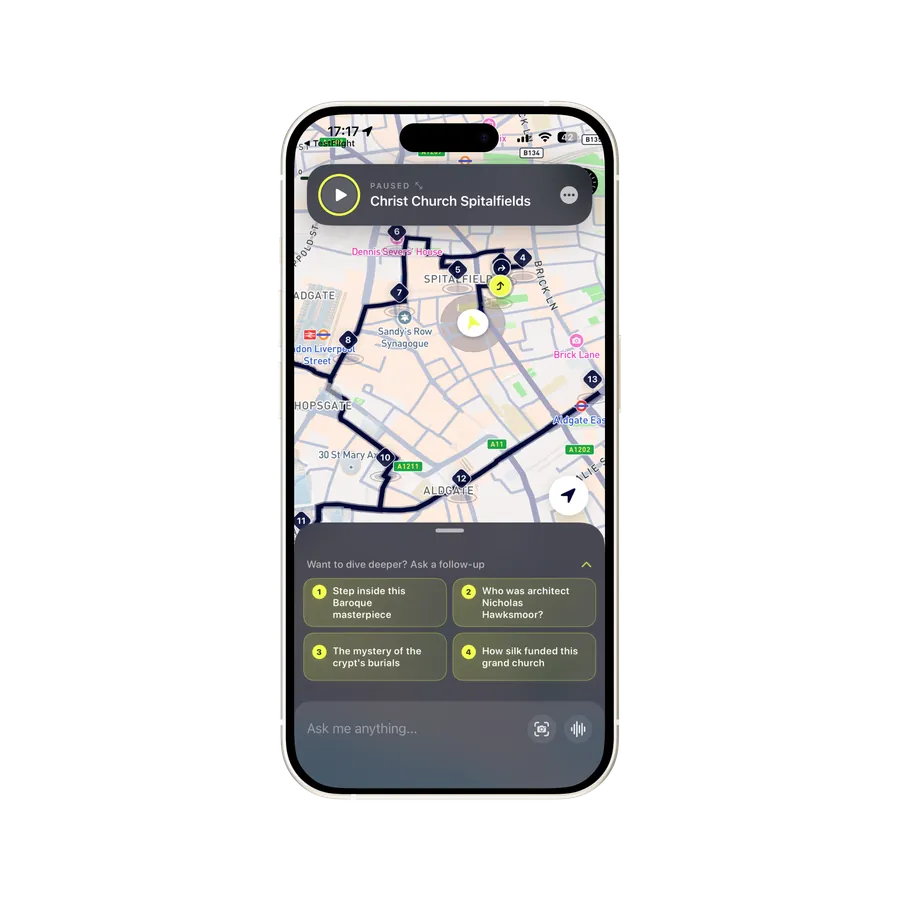
Marie de' Medici cutting the original promenade in 1616, Le Nôtre extending the axis, Napoleon ordering the Arc, Haussmann's Étoile, the 1900 expo, the 1918 victory parade, the 1944 liberation, the Yellow Vests in 2018, today's Bastille Day march.

iWander on-demand AI guide

03

Ask anything along the way.

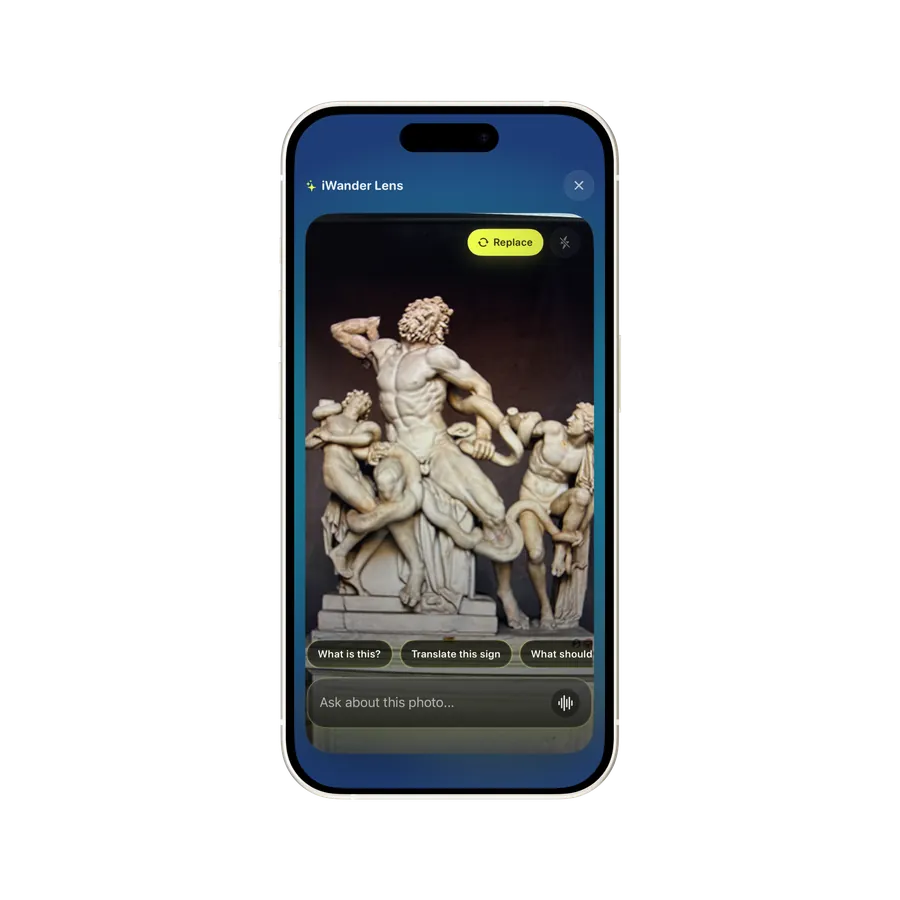
What's that statue? Whose name? Which embassy? What's that café? Point your camera, ask out loud, or type. Your guide answers in seconds.

Works offline · 9 voiced languages · 30 free minutes on signup

What makes it worth walking

A four-century-old idea: walk in a straight line, towards your own glory

The Champs-Élysées is the world's most famous example of urban planning as political theatre. The avenue exists because someone, four hundred years ago, decided that the experience of walking east-west across the city should also be the experience of seeing yourself - or your king, or your republic - reflected in marble, water and stone. Everything since has been built around that decision. The Tuileries, the Concorde, the Arc, the Étoile, the modern Grande Arche of La Défense ten kilometres west - all sit on the same imaginary straight line, and the line is the point.

From swampland to royal axis

In 1616 Marie de' Medici - Henri IV's widow, the same Marie who built the Luxembourg palace and gardens on the Left Bank - ordered a tree-lined promenade west of the Tuileries, the Cours-la-Reine, along the Seine. It was a place for the queen to ride and be seen. In 1667 Louis XIV's gardener André Le Nôtre, fresh from designing Versailles, extended the perspective west across the open fields beyond. The hill where the Arc de Triomphe now stands was called the Butte Chaillot. The road across the fields was called the avenue des Champs-Élysées - the "Elysian Fields", after the paradise of Greek mythology.

For a hundred and fifty years it was a quiet bridle path. Buildings began to appear in the 18th century. The hôtel d'Évreux (now the Élysée Palace) was built in 1722. The Place de la Concorde (then the Place Louis XV) was finished in 1772 - Gabriel's vast geometric square framing the eastern end of the new avenue. The Revolution came; the Place was renamed Place de la Révolution; the guillotine was set up in the middle of it; Louis XVI was beheaded here on 21 January 1793. Over the next year and a half 1,343 others followed - including, in October 1793, Marie Antoinette, and ten months later Robespierre himself.

Napoleon's arch

In 1806 Napoleon ordered an arc de triomphe at the Étoile - a monument to the victories of the Grande Armée, modelled on the Roman arches he had admired in Italy. Construction began in 1806; the architect was Jean-Chalgrin; the budget was vast and the war years were not kind to it. The arch was still unfinished when Napoleon fell in 1815. It was finished by Louis-Philippe in 1836 - 50 metres tall, 45 wide, the largest triumphal arch ever built. Napoleon's funeral procession passed under it in 1840 (his body returned from Saint Helena), as did Victor Hugo's in 1885, the Allied liberation parade in 1944, and every Bastille Day parade since 1880.

Under the arch since 1920 has been the Tomb of the Unknown Soldier - one anonymous French soldier of WWI - and the eternal flame, relit every evening at 18:30 by veterans' associations. The 12 names cut into the inner walls list Napoleon's victorious battles; the bas-reliefs at the base ("La Marseillaise" by François Rude, on the right-hand pillar facing the Champs) are some of the most-photographed sculptures in France.

Haussmann's Étoile

The twelve-avenue star around the Arc - Place Charles de Gaulle, formerly Place de l'Étoile, "Star Square" - was Baron Haussmann's design from 1854, part of his radical reorganisation of Paris for Napoleon III. Before Haussmann the Étoile had five irregular roads converging on it; he ordered twelve, perfectly spaced 30° apart, each named for a Napoleonic marshal or battle. The twelve "hôtels Haussmann" around the perimeter follow the same uniform 1857 façade design - look up and you'll see they are continuous, despite belonging to different buildings.

1900: the world fair that left two palaces and a bridge

The 1900 Exposition Universelle was Paris's third world fair (the previous one, in 1889, gave the city the Eiffel Tower). The 1900 expo left three monuments still around the Champs: the Grand Palais, the Petit Palais, and the Pont Alexandre III. The Grand Palais was the centrepiece - a vast glass-and-iron hall under a 45-metre dome, big enough to host horse shows, art fairs, fencing finals (it was an Olympic venue in both 1900 and 2024), and the legendary Hermès equestrian event. Closed for renovation 2021-2024 - reopened ahead of Paris 2024.

The Petit Palais opposite is the city's fine arts museum, permanently free. The Pont Alexandre III - named for the Russian Tsar, in a moment of Franco-Russian alliance - is the most ornate bridge in Paris: four 17-metre gilded Pegasus statues on the four corners, lamps in the form of mermaids and cherubs, a single 107-metre steel arch that's so flat the bridge doesn't interrupt the river-vista from either bank. Walking across it at sunset, with the Invalides dome ahead and the Eiffel Tower to your right, is one of the most photographed three-minute walks in the world.

From luxury avenue to chain street and back

The Champs was the address from 1900 to about 1980 - Cartier, Guerlain, the Lido cabaret, the embassies, the cafés. By the 1990s, rents had pushed out most of the small boutiques and global chains had moved in - Zara, H&M, Sephora, Disney, Foot Locker. Luxury moved to Avenue Montaigne and Rue du Faubourg Saint-Honoré. In the 2020s a backlash began: the city decided to rebrand the avenue, planted hundreds of new trees, expanded the pedestrian zones, hosted free open-air picnics. The Galeries Lafayette opened a Champs-Élysées branch in 2019 in the former Virgin Megastore building. Louis Vuitton's flagship at #101 reopened after renovation. The avenue is becoming, slowly, an address again.

Questions

Frequently asked

The Champs-Élysées itself is 1.9 km, a 25-minute walk at normal pace from the Arc de Triomphe to the Place de la Concorde. A full walk including the side trips - Avenue Montaigne (luxury), the Grand and Petit Palais, the Pont Alexandre III to the Invalides, and the Madeleine to the Place Vendôme - is 3-3.5 hours. Most people walk it downhill (Arc to Concorde).
Yes - one of the best views in Paris. The 50-metre arch sits at the highest point of the Champs and gives a 360° panorama of the twelve avenues that converge on it (Haussmann's Étoile design from 1854). 284 steps, no lift. Open daily 10:00-22:30 in summer, 10:00-22:00 in winter. €16. Best at sunset for the light down the avenue towards Concorde, with the Eiffel Tower visible to the south.
The 615-metre avenue south of the Champs-Élysées (from Rond-Point to Pont de l'Alma) - Paris's most concentrated luxury street. Dior at #30 (the house's historic headquarters, with the museum upstairs), Chanel at #50-52, Louis Vuitton, Saint Laurent, Valentino, Givenchy, Prada. The Théâtre des Champs-Élysées (1913, where Stravinsky's Rite of Spring premiered) at #15. Plaza Athénée hotel at #25.
It depends. The Champs itself today is mid-market and chain-heavy: Zara, H&M, Sephora, Foot Locker, Disney Store, Nike Townhouse, Apple Store, the famous Lido building (now Galeries Lafayette Champs-Élysées). Real luxury moved to Avenue Montaigne and Rue du Faubourg Saint-Honoré. For Paris brands at fair prices, walk to Galeries Lafayette or Printemps near the Madeleine.
The 8.6-hectare square at the eastern end of the Champs - the largest in Paris and one of the largest in Europe. Built 1755 by Ange-Jacques Gabriel for Louis XV; renamed during the Revolution (Louis XVI was guillotined here in 1793, followed by 1,300 others, including Marie Antoinette and Robespierre). The Luxor obelisk in the centre was a gift from Egypt in 1830 - 23 metres of pink granite, 3,300 years old. The two fountains either side date from 1840.
The vast glass-and-iron exhibition hall built for the 1900 Paris Exposition, south of the Champs on Avenue Winston Churchill. Closed for renovation 2021-2024, reopened ahead of the Paris 2024 Olympics (it hosted the fencing and taekwondo). Now back to art fairs (FIAC, Paris Photo), the Saut Hermès equestrian event, and major temporary exhibitions. The Petit Palais opposite (also 1900) is permanently free - a city-of-Paris fine arts museum, often missed.
Métro: Charles de Gaulle-Étoile (1, 2, 6, RER A) is right at the Arc; Franklin D. Roosevelt (1, 9) is the middle of the avenue; Champs-Élysées-Clemenceau (1, 13) is near the Grand Palais; Concorde (1, 8, 12) is the east end. The avenue is best walked east-to-west or west-to-east, depending on whether you want to climb up to the Arc or roll downhill to the Concorde.
Yes. Download a walk over Wi-Fi at your hotel before you head out. French SIMs (Orange, Free Mobile) are cheap and 4G coverage is excellent across central Paris. iWander runs entirely on-device once downloaded.

How to find it

Getting to the Champs-Élysées

Arrondissement
8th (Right Bank, west of Tuileries)
Nearest métro
Charles de Gaulle-Étoile (1, 2, 6, RER A) at Arc; Franklin D. Roosevelt (1, 9) middle; Concorde (1, 8, 12) at east end
From CDG airport
RER B + métro 1 (45 min) · about €12. Or shuttle bus from Étoile direct (50 min)
From Orly
Orlyval + RER B + métro 1 (50 min) · about €15
Best season
April-June and September-November. December has the Christmas market (lower Champs)
When to walk
Sunset (Concorde end). 1st Sunday of month: car-free Champs (paradise). Avoid 14 July afternoon (parade), New Year's Eve

The headline sights

Three landmarks to anchor your walk

Pull the audio walk around any of these and the rest of the 8th falls into place.

The Arc de Triomphe

Place Charles de Gaulle (formerly Étoile). 50m, 284 steps to the top, Tomb of the Unknown Soldier at the base. Flame relit daily at 18:30. Open 10:00-22:30 summer / 10:00-22:00 winter. €16. Underground tunnel from the métro - never cross the roundabout on foot.

Walk the Arc

Place de la Concorde

The 8.6-hectare square at the foot of the avenue. The 23-metre Luxor obelisk (a gift from Egypt's Mohamed Ali in 1830, 3,300 years old). Twin fountains, eight statues of French cities. Site of Louis XVI's execution in 1793, and the original Bastille Day celebrations of 1880.

Walk the Concorde

Pont Alexandre III

The most ornate bridge in Paris, built for the 1900 expo. Four gilded Pegasus statues on the corners, 32 lamps held by cherubs and mermaids, a single flat 107-metre arch. The walk south from the Grand Palais across the bridge to the Esplanade des Invalides is six golden minutes - especially at sunset, with the Eiffel Tower visible to the west.

Walk the bridge

Other Paris neighbourhoods to wander

Walk somewhere else in Paris

Build any Champs walk you want.

Tell us a theme, a question, a vibe - Arc to Concorde, Avenue Montaigne, the 1900 palaces, a sunset walk, a luxury afternoon, Bastille Day - and your walk is ready in 30 seconds.

Get the iWander app

30 free minutes on signup · Subscriptions from $10/mo · Cancel anytime

Updated 19 May 2026 by the iWander local team · Curated for accuracy