AboutEnterprise solutionsGet the app
Free walking tour · Greenwich · London

Walk Greenwich,
your way.

Free Greenwich walking tour - Observatory, Cutty Sark, Maritime, Painted Hall, in 30 seconds

Your free walking tour of London's maritime-history half-day - the Prime Meridian, the last tea clipper, the Painted Hall ceiling, the world's oldest royal park, all in one UNESCO-listed square mile. Pick a walk below or tell us a theme. Works offline, 9 voiced languages, 30 free minutes on signup.

Or pick your walk

Local knowledge

What we'd tell you on day one

Six things that change how you walk Greenwich.

01

Take the river boat one way.

The Thames Clipper (Uber Boat) from Westminster Pier to Greenwich takes 35-45 minutes and gives you the scenic arrival - past Tower Bridge, Canary Wharf, the Isle of Dogs - that the DLR can't match. £10 single. Take the boat out, take the DLR back (15 min via Cutty Sark - Bank); or DLR out, river boat back at sunset. Either combination is a Greenwich classic.

02

Free is most of Greenwich.

The Old Royal Naval College courtyards and grounds: free. The National Maritime Museum: free. The Queen's House and its art collection (Inigo Jones's first Palladian building, the Armada Portrait of Elizabeth I): free. Greenwich Park: free. The view from the Observatory's hill (free even if you don't go inside the Observatory itself): free. The Foot Tunnel: free. Only the Observatory interior, the Painted Hall, the Cutty Sark, and special exhibitions charge admission. You can do a substantial Greenwich day for free.

03

The Park view is the best free view in London.

Climb the hill in Greenwich Park up to the Royal Observatory's courtyard. The hill is about 47 metres above the river - high enough that you can see central London 9 km west: the Old Naval College framing the view immediately below you, the Queen's House between its quadrangles, the river, Canary Wharf (the closer skyscrapers to the north), the City skyline beyond, the Shard, the BT Tower in the distance. On a clear day you can see Wembley. Better than the Shard (which costs £32) and equally photogenic. Free.

04

The Painted Hall is the under-visited masterpiece.

James Thornhill's 1707-1727 ceiling in the Old Royal Naval College dining hall is one of the largest Baroque painted spaces in Europe - about the same scale as the Sistine Chapel ceiling, in a comparable European-Baroque visual register, and far less visited than the Sistine. About 200,000 square feet of painted surface; Thornhill spent 19 years on it. The hall was used as a working sailors' dining room until 1869 - the sailors hated it ("we eat with the King looking at us"). Restored 2016-2019. £15 entry with included audio guide. Allow 60-90 min. Almost no queues even in summer.

05

The Prime Meridian queue is short on a weekday.

The brass strip marking 0° longitude in the Royal Observatory courtyard is the most-photographed spot in Greenwich. Weekends the queue can be 30-45 minutes; weekdays it's typically 5-10 minutes. The Observatory opens 10:00 and the courtyard often has 200-300 visitors by 11:00. Come at 10:00 sharp, or come on a Tuesday-Thursday for a calm experience. You stand with one foot in each hemisphere; the photo is canonical.

06

Greenwich Market is a Wednesday-to-Sunday thing.

The covered Victorian market in the centre of Greenwich (just south of Cutty Sark) is busiest Wednesday-Sunday with the antiques/crafts traders, plus the food court (about 25 vendors) that operates daily 11:00-17:30. Wednesday is the antique market day; Thursday-Sunday is the general fashion/crafts mix. The Old Brewery pub on the same square is a good lunch alternative; the food court has more variety. Closed Mondays and Tuesdays.

How it works

How iWander walks Greenwich with you.

Three things, in 30 seconds.

iWander home screen

01

Type your walk.

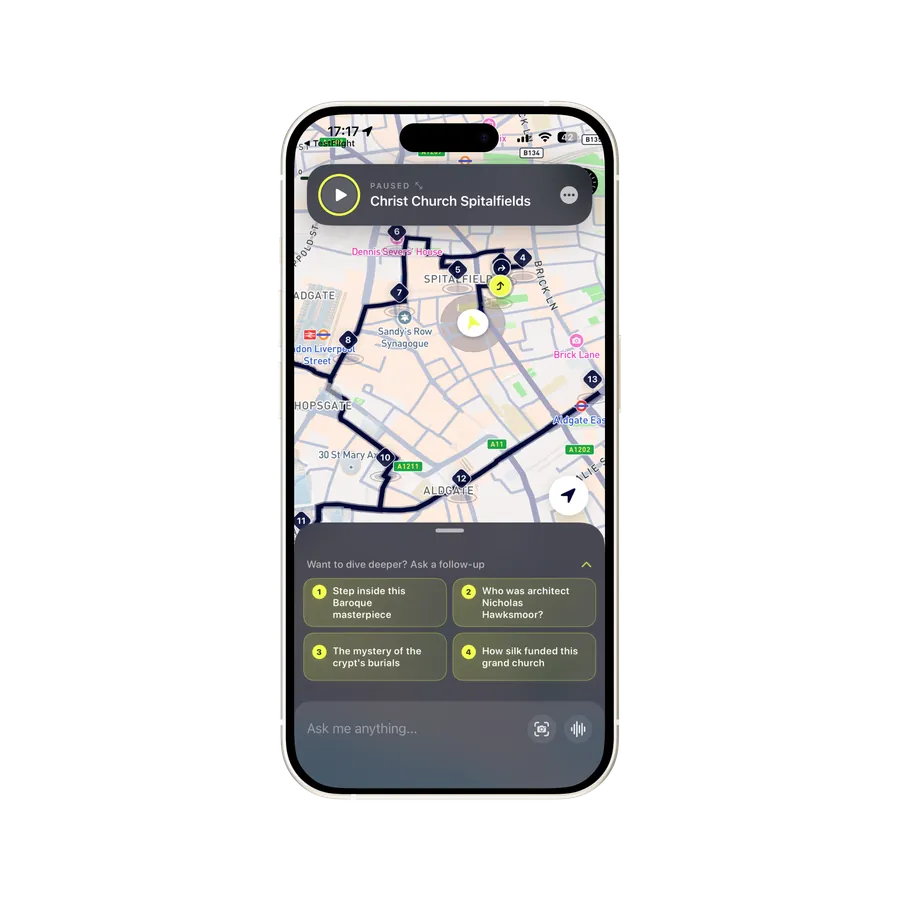
Any building, theme or vibe. "Observatory and Prime Meridian", "Painted Hall walk", "Maritime Museum free hours", "Foot Tunnel + Canaletto view", "Park sunset". iWander writes you the walk in 30 seconds.

iWander audio walk in progress

02

Hear the story as you walk.

Henry VIII born here in 1491, Elizabeth I born here in 1533, Inigo Jones building the Queen's House in 1635, Wren's Naval Hospital, Thornhill's 19 years on the Painted Hall, John Harrison solving the longitude problem, the 1884 establishment of the Prime Meridian, the 1954 Cutty Sark mounting, today's UNESCO Maritime Greenwich.

iWander on-demand AI guide

03

Ask anything along the way.

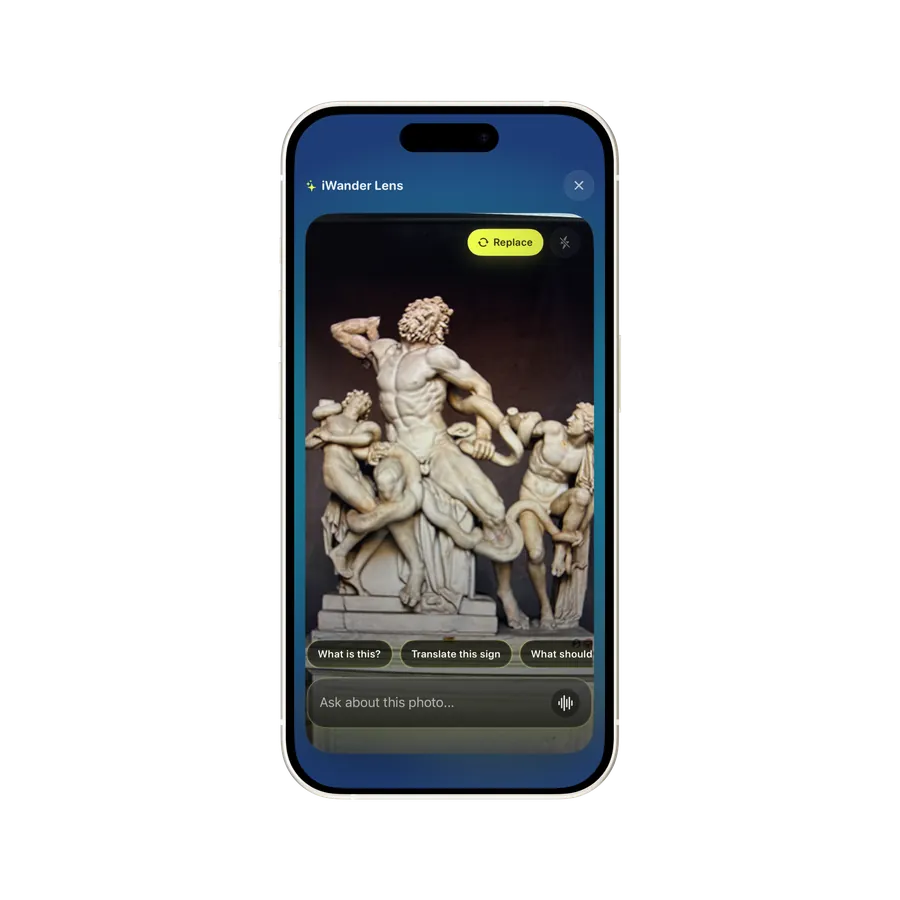
Whose monument? Which ship? When was that finished? Point your camera, ask out loud, or type. Your guide answers in seconds.

Works offline · 9 voiced languages · 30 free minutes on signup

What makes it worth walking

The royal town that gave the world its time zones

Greenwich is the only London neighbourhood that has shaped the rest of the world more than the world has shaped it. Time itself - the 24-hour clock you wear on your wrist, the global standard for "what time is it now" - is set from this hill, by international agreement, since 1884. The 0° meridian of longitude - the line from which every other point on Earth is mapped east or west - passes through the building behind you. The British naval power that mapped most of the world's coastlines for two centuries trained its officers here. The clippers that brought tea from China docked at the river immediately below. Greenwich is small enough that you can walk all of it in a day, and substantial enough that the day shapes how you understand the rest of the world.

From royal palace to royal hospital

The Greenwich riverside has been royal property since the 1430s. Humphrey Duke of Gloucester built a palace here in 1433, surrounded by hunting parks - the origin of Greenwich Park, the oldest enclosed royal park in London. Henry VII rebuilt the palace as the Palace of Placentia in 1498. Henry VIII was born in the palace in 1491; Mary I in 1516; Elizabeth I in 1533. The palace was where Anne Boleyn was arrested in 1536. The Tudors and the early Stuarts lived here as much as at Whitehall.

Charles II began to replace the medieval palace with a new Baroque palace in 1664, but the work stopped in 1672 with only one wing complete. The Stuart and Hanoverian monarchs preferred St James's Palace and later Windsor; Greenwich was abandoned. In 1694 Queen Mary II - whose husband William III had won the Battle of La Hogue at sea in 1692 - ordered the half-built palace converted into a hospital for retired naval seamen, "The Royal Hospital for Seamen at Greenwich". Christopher Wren was the architect; he worked here from 1696 until his death in 1723, designing the four quadrangles around the Queen's House, with John Vanbrugh and Nicholas Hawksmoor as deputies. The hospital received its first pensioners in 1705 and continued as a naval pensioners' hospital until 1869.

The Painted Hall

James Thornhill - the English Baroque painter and master of the Royal Society of Arts - was commissioned in 1707 to paint the dining hall ceiling of the Naval Hospital. He spent 19 years on it. The Lower Hall ceiling depicts William III, Mary II and an allegory of Peace and Liberty defeating Tyranny. The Upper Hall continues with Queen Anne and George I. The walls add panels of British naval history. The result is one of the largest painted Baroque interiors in Europe - about 200,000 square feet of painting, comparable in scale and quality to the Sistine Chapel ceiling.

The hall was used as the sailors' dining room until 1824 (the pensioners reportedly hated it - the painted figures glared down at them while they ate). It then served various ceremonial purposes; Nelson's body lay in state here for three days in January 1806 before being taken up the Thames to St Paul's. The Painted Hall was restored 2016-2019 - the painting was cleaned, the lighting reworked, the interior repointed. Today entry is £15 with included audio guide; visit numbers are low compared with other major London paintings, partly because Greenwich is a half-day from central London. The hall is one of the most underrated treasures in the city.

The Observatory and the Prime Meridian

Charles II founded the Royal Observatory in 1675 to "find the so-much desired longitude" - the problem of how to determine ships' east-west position at sea. Christopher Wren designed the small brick observatory building on the hill above Greenwich (his only surviving secular commission outside the City of London). John Flamsteed was the first Astronomer Royal; the work of finding longitude - mostly through better lunar tables and, eventually, better clocks - continued for about a century.

John Harrison's marine chronometers - H1 (1735), H2 (1741), H3 (1759) and H4 (1761) - finally solved the longitude problem by making clocks accurate enough to keep time at sea. H4 was tested on a 1761-62 voyage to Jamaica and lost only 5 seconds in 81 days. Harrison's four chronometers are now on display at the Observatory - one of the most beautiful and important sets of scientific instruments in the world. The 1953 dramatisation Longitude (Dava Sobel's bestseller; the 2000 Granada Television film with Michael Gambon) told Harrison's story to a wider audience.

The Prime Meridian itself was established at Greenwich by international agreement at the 1884 International Meridian Conference in Washington. 25 countries voted for Greenwich as 0° longitude; the French initially abstained (in protest at a non-Paris meridian) but adopted GMT in 1911. The brass strip in the Observatory courtyard marks 0° on the ground; you stand with one foot in the eastern hemisphere and one foot in the western. The Observatory is now part of Royal Museums Greenwich (along with the National Maritime Museum and the Queen's House) and charges admission (£18+) to enter the historic buildings. The courtyard with the brass strip is included with admission; the surrounding park views are free.

The Cutty Sark and the maritime museum

The Cutty Sark was launched in 1869 in Dumbarton, Scotland, as a clipper for the China tea trade. By the time she was finished, however, the new Suez Canal was about to open, making steamships much more economical for the tea route. The Cutty Sark mostly carried wool from Australia and various other cargoes; she was always a fast ship - she once sailed from Newcastle, Australia to London in 73 days - but never as profitable as her builders hoped. After a Portuguese commercial period 1895-1922, she was bought by a retired British captain for £3,750 and converted into a cadet training ship. From 1954 she was permanently dry-docked at Greenwich as a museum.

On 21 May 2007 a fire severely damaged the ship; about 50% of the surviving wooden hull was destroyed. The £50m restoration completed in 2012 lifted the entire ship 3 metres into the air on glass supports, so visitors can walk underneath the hull (the keel, the propeller, the underwater design) - a unique perspective on a 19th-century sailing ship. Entry is £25. The National Maritime Museum next door (free admission, the world's largest maritime museum, including Nelson's uniform from the Battle of Trafalgar - the actual one, with the musket-ball hole through the shoulder) and the Queen's House (free, Inigo Jones's first English Palladian building of 1635, holding the Armada Portrait of Elizabeth I) complete the Royal Museums Greenwich cluster.

The wider neighbourhood

Maritime Greenwich was designated a UNESCO World Heritage Site in 1997 - the Queen's House, the Old Royal Naval College, the Observatory, Greenwich Park, the National Maritime Museum, the Cutty Sark, the Greenwich riverside, and the Royal Observatory's astronomical work. The wider Greenwich town - the streets between Cutty Sark and the rail station - is a working London neighbourhood with Georgian and Victorian houses, the indoor Greenwich Market, several good pubs (the Trafalgar Tavern on the river, the Spanish Galleon on College Approach), restaurants, and the Foot Tunnel under the river to the Isle of Dogs.

The 2012 Olympics used Greenwich Park for the equestrian events, including dressage and the cross-country phase of the modern pentathlon. The temporary stadium was removed after the Games and the park returned to normal - free, open daily, with the deer enclosure in the south-east corner and the Observatory at the top of the hill. The view from the hill is, as it has been since 1675, the most-painted view in London.

Questions

Frequently asked

Greenwich is the historic royal-and-maritime town on the south bank of the Thames in south-east London, SE10 postcode, about 9 km east of London Bridge. The Maritime Greenwich district is a UNESCO World Heritage Site since 1997, containing the Royal Observatory (Prime Meridian at 0° longitude), the National Maritime Museum, Cutty Sark, the Old Royal Naval College, Queen's House, Greenwich Park (the oldest royal park, 1433), and Greenwich Market.
A full Greenwich walk - Cutty Sark, the Old Royal Naval College, the Painted Hall, the National Maritime Museum, Queen's House, the climb up to the Royal Observatory and the Prime Meridian, Greenwich Park, Greenwich Market - takes a full day (5-6 hours including museum entries). A focused walk is 2.5-3 hours.
The 0° meridian of longitude - the line from which all other longitudes are measured east and west, established at Greenwich by international agreement at the 1884 International Meridian Conference. The line passes through the original 1675 Airy Transit Circle telescope at the Royal Observatory. The actual brass strip marking 0° on the ground is one of the most-photographed objects in London - you stand with one foot in the eastern hemisphere and one in the western.
The 1869 British clipper ship - one of the fastest sailing ships ever built, originally for the China tea trade. The last surviving tea clipper. After 100+ years as a working ship and museum, the Cutty Sark was permanently mounted in 1954 in a dry dock at Greenwich. A devastating 2007 fire required a full restoration, completed in 2012, that lifted the ship into the air on glass supports so visitors can walk underneath. £25 entry; allow 90 minutes.
Yes - the views alone are worth it. The Observatory sits on a hill in Greenwich Park at about 47 metres elevation. From the courtyard you look north across central London. The actual Observatory buildings (£18+ entry) contain the 1675 Royal Observatory by Christopher Wren, the original Airy Transit telescope, John Harrison's H1-H4 marine chronometers, and the planetarium. Free to walk in the surrounding park.
James Thornhill's 1707-1727 baroque ceiling and wall paintings in the dining hall of the Old Royal Naval College - one of the most extravagant pieces of Baroque painting in Europe. About 200,000 square feet of painted surface; took 19 years. The hall was used as a sailors' dining room until 1869. Restored 2016-2019; entry now £15 with audio guide. One of the under-visited masterpieces of London.
A 370-metre pedestrian tunnel under the Thames, opened in 1902, connecting Greenwich (south bank) to Island Gardens on the Isle of Dogs (north bank). Free, open 24 hours. Walk down 87 steps (or use the lifts) on either side. The north-bank exit at Island Gardens gives the most-photographed view of the Old Royal Naval College and the Greenwich riverside - the view Canaletto painted in 1750.
DLR (Docklands Light Railway): Cutty Sark for Maritime Greenwich (the main entry) - 15 min from Bank station. Greenwich Pier: Thames Clippers river service - 30-40 min from Westminster Pier. National Rail: Greenwich station (15 min from London Bridge). Foot Tunnel: walk down from Island Gardens DLR on the Isle of Dogs.

How to find it

Getting to Greenwich

Postcode
SE10 (Royal Borough of Greenwich, SE London)
Nearest transport
DLR: Cutty Sark (main) and Greenwich. National Rail: Greenwich. Thames Clipper: Greenwich Pier
From Heathrow
Elizabeth Line to Canary Wharf then DLR to Cutty Sark (75 min) · about £12
From Gatwick
Thameslink to London Bridge then National Rail to Greenwich (60 min) · about £20
Best season
April-October. Park beautiful in spring (daffodils) and autumn. Observatory needs clear day for the view
When to walk
Open 10:00 to beat the Prime Meridian queue. Painted Hall any time (rarely queues). River boat back at sunset

The headline sights

Three landmarks to anchor your walk

Pull the audio walk around any of these and the rest of Greenwich falls into place.

Royal Observatory + Prime Meridian

The 1675 Wren observatory at the top of the Greenwich Park hill. Prime Meridian (0° longitude) in the courtyard. Inside: the Airy Transit telescope, John Harrison's H1-H4 marine chronometers, the planetarium. £18+ entry; surrounding park free.

Walk the Observatory

Old Royal Naval College + Painted Hall

Wren's masterpiece (1696-1712). Built as a naval hospital, became a naval college 1873, now restored as a museum complex. Four quadrangles around the Queen's House. Painted Hall (Thornhill, 1707-27, £15 inside) is the under-visited gem.

Walk the Naval College

Cutty Sark + Greenwich Market

The 1869 clipper ship in permanent dry dock at the river end of Greenwich (£25 entry; walk underneath the hull) plus the covered Victorian Greenwich Market just south (Wed-Sun antiques + crafts; daily food court 11:00-17:30). Walk between them in 3 minutes.

Walk the riverside

Other London neighbourhoods to wander

Walk somewhere else in London

Build any Greenwich walk you want.

Tell us a theme, a question, a vibe - Prime Meridian at 10:00, the Painted Hall, Cutty Sark + walk underneath, river boat back at sunset, Greenwich Park view - and your walk is ready in 30 seconds.

Get the iWander app

30 free minutes on signup · Subscriptions from $10/mo · Cancel anytime

Updated 19 May 2026 by the iWander local team · Curated for accuracy