AboutEnterprise solutionsGet the app
Free walking tour · Shoreditch · London

Walk Shoreditch,
your way.

Free Shoreditch walking tour - Brick Lane, Spitalfields, street art, Columbia Rd, in 30 seconds

Your free walking tour of East London's creative quarter - Brick Lane curry and bagels, Old Spitalfields Market, the densest street-art scene in the UK, Columbia Road Flower Market on Sundays. Pick a walk below or tell us a theme. Works offline, 9 voiced languages, 30 free minutes on signup.

Or pick your walk

Local knowledge

What we'd tell you on day one

Six things that change how you walk Shoreditch.

01

Sunday is the day.

Three things only happen on Sundays in Shoreditch: Columbia Road Flower Market (08:00-15:00), the full Old Spitalfields Sunday market with all 100+ stalls operating, and Brick Lane's weekend vintage/food markets in the Truman Brewery yards. Sunday morning 09:00-12:00 is the magic window - all three are open, the crowds haven't yet arrived. From 13:00 Sundays the streets are wall-to-wall.

02

The Brick Lane curry strip is mostly average.

The south half of Brick Lane (Whitechapel Road to Hanbury Street) is densely lined with curry-house touts on the pavement competing on aggressive sales tactics. The food in most of these restaurants is interchangeable, mid-quality, and pricier than equivalent places elsewhere in east London. For real Bangladeshi food walk 5 minutes south to Tayyabs (83-89 Fieldgate Street, queue 30-45 min, no reservations, the best Punjabi in London). For modern Indian: Gunpowder (11 White's Row, Spitalfields). The Brick Lane experience is the walk - the food is the side trip.

03

Beigel Bake is the cheapest 24-hour meal in London.

159 Brick Lane. The yellow-fronted Ashkenazi bakery, since 1974, never closes. Salt-beef beigel (£8 in 2026 - reluctantly inflated from £6 over five years) with mustard is the canonical order. Cream cheese (£3.50), smoked salmon (£5), or just buttered (£1.20) also work. Queue any time of day - lunch, midnight, 04:00 on a Saturday. The line moves fast. Cash or card. The neighbouring Beigel Shop at 155 - older (1855, the original) - closes Sundays but is the more authentic spot if you can time it right.

04

Street art changes weekly - don't book a tour.

The Shoreditch street art changes faster than most guides can keep up. Walls get painted over every 1-4 weeks. The Banksy pieces are mostly gone or protected behind perspex (the famous "Sniper" piece on Stoney Lane is buffed; "Boy with a Hammer" on Princelet Street is behind glass and partially repainted). The best approach: walk Hanbury Street, Princelet Street, Heneage Street, Buxton Street, Brick Lane between Bethnal Green Road and Old Truman Brewery. You'll find current commissioned pieces by ROA, Stik, Phlegm, Conor Harrington, Eine. Free; no guide needed.

05

Christ Church Spitalfields is free.

The white Hawksmoor church on Commercial Street (1729) is one of the city's six Nicholas Hawksmoor churches - the most divisive English baroque architect. Free to enter, open most days 11:00-16:00. The interior was restored 2004-2005 after decades of decay. Concerts most Friday evenings (often free or £10). The crypt restaurant Krio - in the former burial vault - is one of east London's best lunch spots. The church anchors the south end of Old Spitalfields Market.

06

Columbia Road needs 08:00.

The Sunday-only flower market peaks 11:00-13:00 with wall-to-wall crowds. The traders set up from 06:30 and the market technically opens at 08:00. Come between 08:00 and 09:30 for the empty street, the photogenic shopfronts (most of the side shops only open Sundays - tea rooms, vintage shops, design studios), and the friendliest interaction with the traders. Bargains improve dramatically after 14:00 when stallholders want to clear stock and will sell bundles half-price. Closest tube: Hoxton (Overground); from Shoreditch High Street, a 10-min walk north.

How it works

How iWander walks Shoreditch with you.

Three things, in 30 seconds.

iWander home screen

01

Type your walk.

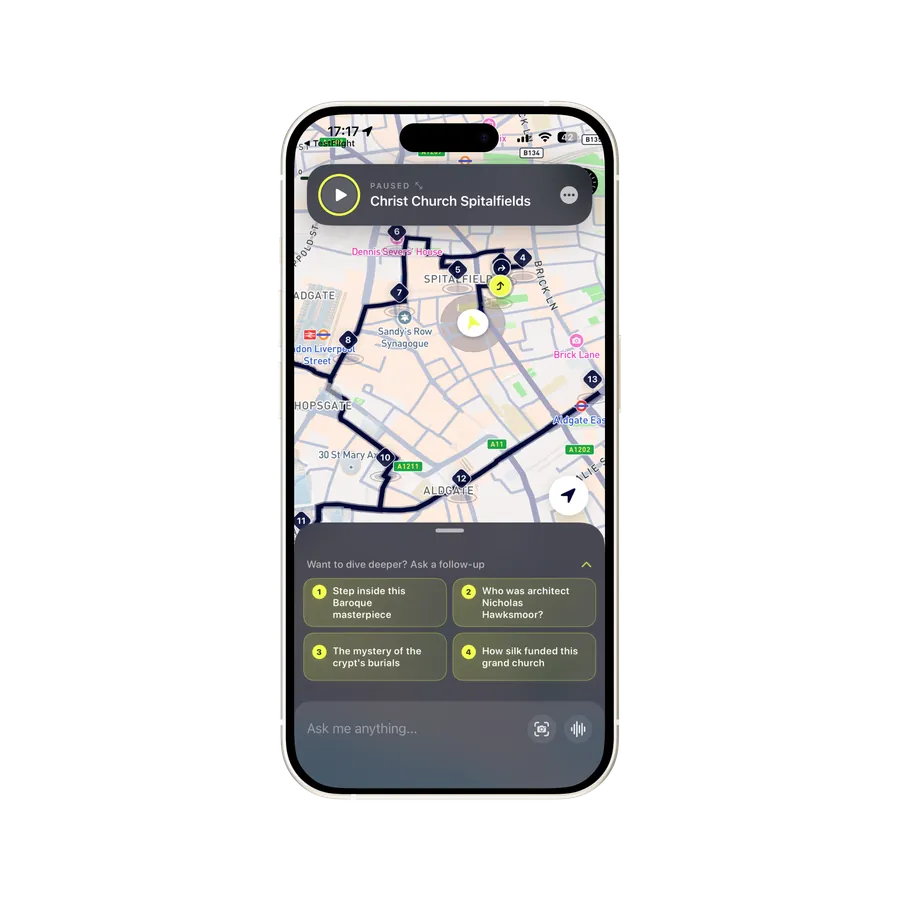
Any street, theme or vibe. "Brick Lane curry strip", "Sunday morning Columbia Road", "Banksy and ROA spots", "Spitalfields Thursday antiques", "Beigel Bake 04:00". iWander writes you the walk in 30 seconds.

iWander audio walk in progress

02

Hear the story as you walk.

The medieval priory, the Huguenot silk weavers of the 1680s, the Jewish East End of the 1880s-1940s, the Bangladeshi settlement from the 1970s, the squat scene of the 1980s, the Britart boom (Hirst at the Truman Brewery in 1988), the 2000s gentrification, today's curry-strip-vs-craft-coffee tension.

iWander on-demand AI guide

03

Ask anything along the way.

Whose mural? Which curry house? What's that brewery building? Point your camera, ask out loud, or type. Your guide answers in seconds.

Works offline · 9 voiced languages · 30 free minutes on signup

What makes it worth walking

An immigrant quarter that has been four different immigrant quarters in three centuries

Shoreditch is the closest you can get to a single neighbourhood that explains London's migrant history. Four major waves of immigration have arrived here, settled, built communities, and either moved out as the next wave moved in or quietly merged into the next layer. The Huguenots (French Protestants, 1680s-1700s) built the silk-weaving industry; the Irish (1830s onwards) worked on the railways; the Ashkenazi Jews from Eastern Europe (1880s-1940s) built the rag trade; the Bangladeshis (1960s-present) built the curry industry and, briefly, the global perception of "Banglatown". Each community left its own architecture, its own food, its own institutions. Walk Shoreditch today and you can read all four communities in the same five blocks.

The Huguenots and the silk weavers

The first big migrant wave was the Huguenots - French Protestants fleeing Louis XIV's revocation of the Edict of Nantes in 1685. About 50,000 came to England; most settled in London's east end, particularly Spitalfields, which was outside the City of London's tight craft guild monopolies. The Huguenots were skilled silk weavers; within 20 years Spitalfields was the centre of English silk weaving, with about 25,000 looms in operation by 1750. The Huguenot houses - tall, narrow brick terraces with attic windows specifically designed to maximise daylight for the loom - are still standing on Princelet Street, Wilkes Street and Fournier Street. Many have been preserved by the Spitalfields Trust and lived in continuously since the 1690s.

The silk industry collapsed in the 1830s when free trade and Indian silk imports undercut prices. The weavers became unemployed; the houses fell into multi-occupancy slum use; the wider neighbourhood became one of the poorest in London. The 1888 Whitechapel murders (the "Jack the Ripper" killings, all within a five-block radius of Brick Lane) put the area's reputation on the international map - in the worst possible way.

Jewish East End

The Huguenot houses became the basis for the next wave - Ashkenazi Jews from Russia, Poland and Lithuania fleeing pogroms in the 1880s and 1890s. By 1900 about 150,000 Jews had settled in the East End, with the highest density in Whitechapel, Spitalfields and the streets around Brick Lane. The community built synagogues (the Princelet Street synagogue, 1869, in a converted Huguenot house, is now a museum), bakeries (the original Beigel Shop at 155 Brick Lane, 1855, is still operating), and the textile sweatshops of the "Sentier" rag-trade that fed London's clothing industry for 80 years.

The 1936 Cable Street battle - when local Jews, Irish, communists and trade unionists physically blocked Oswald Mosley's British Union of Fascists from marching through the East End - is the defining moment of pre-war Jewish East End identity. The 1939-1945 Blitz then devastated the physical neighbourhood: large sections of Spitalfields and Bethnal Green were destroyed. The Jewish community, prospering through the post-war recovery, gradually moved north to Stamford Hill (where it remains) and to outer suburbs. By 1980 the Jewish East End was largely gone except for the bakeries and the synagogues converted to mosques.

Brick Lane becomes Banglatown

The third wave was Bangladeshi - mostly from the Sylhet region of north-east Bangladesh - arriving from the 1960s. Many were single male workers initially, finding work in the Hawksmoor church bell tower restoration teams, the rag-trade workshops the Jewish community was leaving, and the kitchens of the small "Indian" restaurants that had been opening since the 1940s. Family reunification through the 1970s and 1980s built a community of about 35,000 Bangladeshis in Tower Hamlets. The curry restaurants on Brick Lane proliferated: by 2000 there were over 50 in a 500-metre strip. The street was officially renamed "Banglatown" in 1998 with bilingual street signs and the Banglatown gateway arch at the south end.

The 2000s gentrification, the rise of more authentic curry destinations (Tayyabs, Lahore Kebab House, Aladin) outside the main strip, the closing of the smaller textile workshops, and Brexit-era restrictions on family migration have all reduced Brick Lane's role as the Bangladeshi heart. Many of the second- and third-generation British Bangladeshi families have moved to outer east London (Newham, Redbridge) where housing is cheaper. The curry houses remain but the residential community is thinning. The neighbourhood is in transition.

The art scene and the gentrification

The fourth wave - if you can call it that - was the artists. From the late 1980s the cheap, abandoned warehouse space in Shoreditch and Hoxton attracted a generation of art students from Goldsmiths and the Royal College. The Young British Artists movement - Damien Hirst, Tracey Emin, Sarah Lucas, Gary Hume, Gavin Turk - had their breakthrough show "Freeze" at a disused Surrey Quays warehouse in 1988 and their second major exhibition at the Truman Brewery yards in 1990. The Truman Brewery itself - a 1666 brewery that closed in 1989 - was bought by entrepreneurs and converted into the original creative-quarter complex of studios, market space and event halls. The White Cube gallery opened on Hoxton Square in 2000 and showed Hirst, Emin and the rest at the height of the YBA boom.

From there gentrification accelerated. Tech companies moved into Old Street's "Silicon Roundabout" from 2008. Hotels opened (the Hoxton Hotel in 2006 was the first design hotel in the area). Boxpark - the world's first "pop-up shopping mall" made of 60 stacked shipping containers - opened on Bethnal Green Road in 2011. Property prices in Shoreditch and Hoxton are now among the highest in inner east London. The Bangladeshi families, the rag-trade workshops, the original Britart squats - all mostly gone, mostly priced out.

The Shoreditch of 2026 is the gentrified outcome of all four migrant waves. The buildings are still here: Huguenot houses, Jewish bakeries, Bangladeshi curry houses, the Truman Brewery, the early YBA gallery spaces (now mostly converted to offices). The street art still changes weekly. The Sunday markets - Columbia Road, Brick Lane, Spitalfields - still draw 200,000+ visitors a weekend. The neighbourhood is unrecognisable from 30 years ago, and recognisably itself.

Questions

Frequently asked

Shoreditch is the East London neighbourhood immediately east of the City of London, in the E1, E2 and EC2 postcodes (London Borough of Hackney and a sliver of Tower Hamlets). It is the heart of the East End - historically a working-class textile and furniture-making quarter, later the centre of London's Bangladeshi-British community (Brick Lane), and from the 1990s the most rapidly-gentrified neighbourhood in London. Today it is one of the city's strongest food, nightlife, fashion and street-art districts.
A full Shoreditch walk - Liverpool Street to Old Spitalfields Market, Brick Lane (the curry strip and Beigel Bake), the Truman Brewery, the street-art walls between Hanbury Street and Buxton Street, Shoreditch High Street, Boxpark, the Hoxton end, and Columbia Road for the Sunday flower market if your timing is right - takes 3 to 3.5 hours at a relaxed pace.
Shoreditch has been one of the world's most-photographed street-art districts since around 2005, when Banksy began using the area for high-profile pieces. The streets between Hanbury Street, Buxton Street, Heneage Street and Princelet Street form the densest cluster - work by Banksy (now mostly behind perspex protection), ROA, Stik, Phlegm, Eine, Invader. The walls change constantly.
Sundays only, 08:00 to about 15:00. The 250-metre east-west street in the north of Shoreditch fills with 50+ flower and plant stalls, plus the permanent shops on both sides which only open on Sundays. Bargains improve dramatically after 14:00 when traders want to clear stock. The crush peaks 11:00-13:00; come at 08:00 for the quietest experience.
Brick Lane has had the densest concentration of curry houses in the UK since the 1970s. Most of the Brick Lane curry houses compete on touts on the pavement and price, not on food quality. For genuinely good Bangladeshi food, walk one block off to the side: Tayyabs (Fieldgate Street, 5 min south, no reservations, queue 30-45 min) or Gunpowder (Spitalfields, modern Indian small plates). For the Brick Lane experience itself, Aladin or Sheba are decent.
159 Brick Lane - the 24-hour Ashkenazi Jewish bakery that has been on the same spot since 1974 (the older Beigel Shop at 155 is from 1855 - both are still operating, the older one closes Sundays, the 24-hour one never closes). Famous for the salt-beef beigel (£8 in 2026) and the cream cheese beigel (£3.50). Queue at any hour. One of the last working pieces of pre-Bangladeshi Brick Lane history.
A covered Victorian market hall in the south-west corner of Shoreditch where market traders have operated since 1638. The current iron-and-glass roof is 1887-1893. The market trades 7 days a week, with different themed days: Monday-Friday is general (fashion, vintage, antiques); Thursday is antiques; Saturday is mixed; Sunday is the busiest. The food court in the centre has 30+ vendors. Adjacent to Christ Church Spitalfields (Hawksmoor, 1729).
Tube and Overground: Liverpool Street (Central, Circle, Hammersmith & City, Metropolitan, Elizabeth) is the south entry; Shoreditch High Street (Overground) is the central station; Old Street (Northern) is the western entry; Aldgate East (District, Hammersmith & City) is the south-east entry for Brick Lane; Hoxton (Overground) is the north entry for Columbia Road.

How to find it

Getting to Shoreditch

Postcodes
E1, E2, EC2 (East London, Hackney/Tower Hamlets)
Nearest tube
Liverpool Street (Central, Circle, H&C, Metropolitan, Elizabeth); Shoreditch High St (Overground); Old St (Northern); Aldgate East (District, H&C); Hoxton (Overground)
From Heathrow
Elizabeth Line direct to Liverpool Street (50 min) · about £12
From Gatwick
Thameslink to Farringdon then Circle east (60 min) · about £20
Best season
April-October. Columbia Road only on Sundays. Spitalfields/Brick Lane every day; Sundays busiest
When to walk
Sunday 09:00 for Columbia Road, then south to Brick Lane. Thursday for Spitalfields antiques. Friday night for Shoreditch nightlife

The headline sights

Three landmarks to anchor your walk

Pull the audio walk around any of these and the rest of Shoreditch falls into place.

Brick Lane

600m curry-house strip from Whitechapel Road north to Bethnal Green Road. Banglatown gateway arch at south end (1998). Bilingual Bengali street signs. Beigel Bake at #159 (24h, since 1974); Tayyabs (best curry) is 5 min south on Fieldgate Street.

Walk Brick Lane

Old Spitalfields Market

16 Horner Square. Trading since 1638; current Victorian iron-and-glass roof 1887-1893. Open 7 days, with themed days: Thursday antiques, Saturday mixed, Sunday busiest. 100+ stalls + 30+ food vendors. Adjacent to Christ Church Spitalfields (Hawksmoor, 1729).

Walk Spitalfields

The street art quarter

Hanbury, Princelet, Heneage, Buxton Streets between Brick Lane and Commercial Street. Densest mural cluster in the UK. Walls change every 1-4 weeks. Banksy, ROA, Stik, Phlegm, Eine, Invader. Self-guided; free; carry a phone for the changing pieces.

Walk the art quarter

Other London neighbourhoods to wander

Walk somewhere else in London

Build any Shoreditch walk you want.

Tell us a theme, a question, a vibe - Sunday morning Columbia Road, Brick Lane curry strip, the changing street art, Beigel Bake at 04:00 - and your walk is ready in 30 seconds.

Get the iWander app

30 free minutes on signup · Subscriptions from $10/mo · Cancel anytime

Updated 19 May 2026 by the iWander local team · Curated for accuracy