AboutEnterprise solutionsGet the app
Free walking tour · Mayfair · London

Walk Mayfair,
your way.

Free Mayfair walking tour - Bond Street, Savile Row, Shepherd Market, in 30 seconds

Your free walking tour of London's wealthiest postcode - Bond Street luxury, Savile Row tailors, Shepherd Market's hidden village, the Royal Academy, the historic hotels. Pick a walk below or tell us a theme. Works offline, 9 voiced languages, 30 free minutes on signup.

Or pick your walk

Local knowledge

What we'd tell you on day one

Six things that change how you walk Mayfair.

01

Most of Mayfair is free to walk.

Despite the reputation, Mayfair's surface is open and free. The Royal Academy courtyard is free; the Burlington Arcade is free to walk through; the squares (Berkeley, Grosvenor, Hanover) are all public; Bond Street is a public street; Savile Row is a public street and the tailors welcome unhurried browsers; Shepherd Market is a public village. You can walk Mayfair top to bottom and spend nothing, taking in luxury without buying anything, and the staff will be polite about it. The cost only kicks in if you sit down for coffee or a meal.

02

The Burlington Arcade Beadles still wear top hats.

The 1819 arcade has its own private police force - the Beadles, in black frock coats, gold-trim hats and white gloves. They have been here since the arcade opened in 1819 and are the world's oldest still-operating private police force. They enforce the arcade's rules: no whistling, no singing, no running, no opening umbrellas, no large parcels. The rules date from the Regency era and have never been formally repealed. The Beadles are polite but firm; they will ask you to stop whistling.

03

Shepherd Market is the secret.

Easy to miss. The market is accessed through narrow alleys off Curzon Street (look for Shepherd Street or White Horse Street) or Hertford Street. Once inside, it is a small pedestrian village - low Georgian buildings, a tiny central square, four pubs, six small restaurants, no through-traffic. The contrast with the surrounding Bond Street formality is the point. Best at lunch or early evening; the pub atmosphere on Ye Grapes' pavement is unrivalled in Mayfair. The neighbourhood was the original site of the chaotic May Fair (1686-1764) that gave Mayfair its name.

04

The Royal Academy Summer Exhibition is the deal.

Every June-August the Royal Academy hosts its Summer Exhibition - the world's largest open-submission art show, running continuously since 1769. Over 1,200 works selected from about 12,000 entries; about a third are for sale (typically £200-£20,000); the rest are RA Members and Honorary Academicians. Tickets £20-25, valid for the full three-month run. The hang is dense, chaotic, often funny, and exhausting in the best way. Allow 2-3 hours. The Sackler Wing is free year-round even when the Summer Exhibition isn't on.

05

Afternoon tea at Claridge's costs £100.

The classic Mayfair experience is afternoon tea at Claridge's, the Ritz, Browns, or the Dorchester. All four serve the canonical version (sandwiches, scones with clotted cream, tiered pastries, free-flow tea) in formal Art Deco or Edwardian rooms. Claridge's tea is currently £85-95 per person depending on day and time slot; the Ritz is £75-85; Browns £75; the Dorchester £75. All require booking 4-8 weeks ahead for weekends. Smart casual dress code (jeans/trainers not allowed). The whole experience takes 2 hours.

06

Bond Street has two halves.

Old Bond Street (south end, Piccadilly to Burlington Gardens) is the older, higher-end half: Cartier, Bulgari, Tiffany, Asprey, Sotheby's, Patek Philippe, Graff diamonds. New Bond Street (north end, Burlington Gardens to Oxford Street) is the longer half: Louis Vuitton, Chanel, Dior, Hermès, Prada. The transition between Old and New is at the Burlington Gardens junction - look for the famous Allies Sculpture (Roosevelt and Churchill on a bench, 1995). Walk south-to-north or north-to-south; either works.

How it works

How iWander walks Mayfair with you.

Three things, in 30 seconds.

iWander home screen

01

Type your walk.

Any street, theme or vibe. "Bond Street auction houses", "Savile Row tailors", "Shepherd Market pubs", "afternoon tea at Claridge's", "Royal Academy Summer Exhibition". iWander writes you the walk in 30 seconds.

iWander audio walk in progress

02

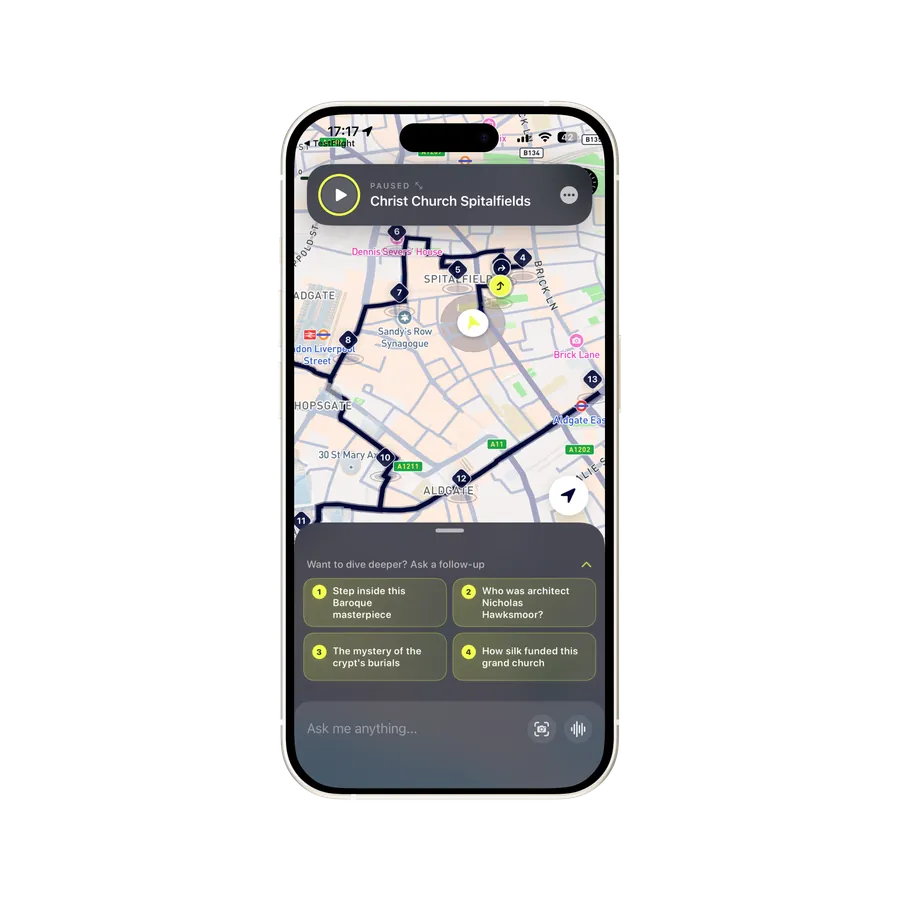
Hear the story as you walk.

The 1686 May Fair, the Grosvenor Estate development of the 1720s, Lord Burlington and the Royal Academy, the Beau Brummell era, the Edwardian club scene, the American embassy in Grosvenor Square, the modern fashion houses, today's hedge-fund Mayfair.

iWander on-demand AI guide

03

Ask anything along the way.

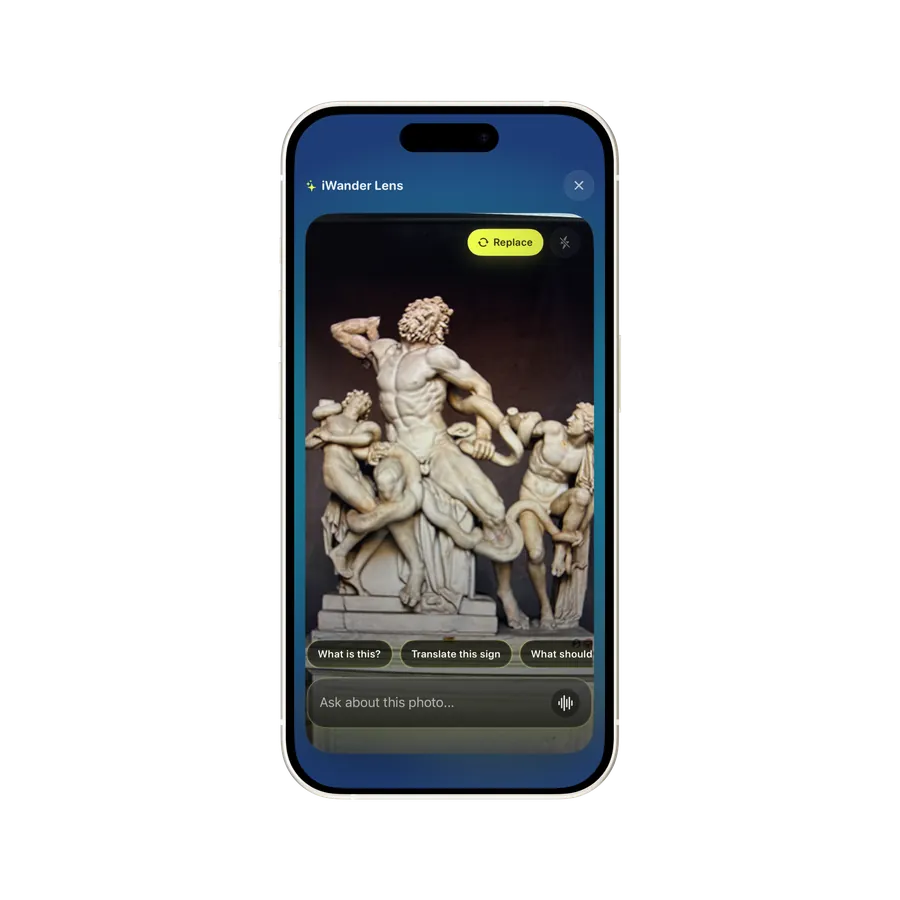
Which embassy? Whose blue plaque? Which tailor? Point your camera, ask out loud, or type. Your guide answers in seconds.

Works offline · 9 voiced languages · 30 free minutes on signup

What makes it worth walking

A chaotic fair, a planned aristocratic suburb, three centuries of monopoly on wealth

Mayfair's name comes from a chaotic 17th-century street fair, but its character was set when the aristocracy shut that fair down. The contradiction is the whole story. For 300 years Mayfair has been the most consistently wealthy postcode in London - the address aristocrats and bankers and oligarchs have picked when they could pick anywhere - because the original 18th-century planners built it to exclude everyone else. The grid was tight, the squares were locked behind keys held only by residents, the buildings were uniform brick fronts that prevented the kind of haphazard growth that built the rest of London. Today the keys are gone (the squares opened to the public in the 1940s) but the grid is intact, the squares are still squares, and Mayfair is still the address.

From open fair to closed estate

The May Fair - a chaotic annual two-week street fair held in what is now Shepherd Market and the surrounding fields - ran from about 1686 to 1764. It was famous for drunken brawls, stalls selling everything from oysters to performing bears, prostitution and gambling. The local aristocracy hated it. The Grosvenor family - who owned the freehold of most of the surrounding land - lobbied successfully to have the fair banned in 1764, and immediately began developing the land as a planned aristocratic suburb.

The Grosvenor Estate (still owned today by the Duke of Westminster, whose family wealth is largely Mayfair freeholds) developed the area through the 1720s-1770s. Grosvenor Square - the second-largest of London's planned squares, after Lincoln's Inn Fields - was laid out in 1725. Berkeley Square followed in 1747. Hanover Square (technically just east, now considered Mayfair's eastern edge) was laid out in 1717-1719. The grid of streets connecting them - Mount Street, Brook Street, North Audley, South Audley, Park Lane - was built up with brick terraces designed to a uniform 99-year leasehold standard that gave the Grosvenor Estate control over every aesthetic detail.

The result, by 1800, was the densest concentration of aristocratic London: dukes, earls, foreign ambassadors, leading politicians, the wealthiest commoners. The 99-year lease structure meant the Grosvenor Estate retained the freehold and effectively the right to refuse occupation; the social filter was tight. Even today, the Grosvenor Estate still owns most of the freehold and still operates a discreet acceptance process for new commercial tenants. Mayfair is the only London neighbourhood where what kind of business goes into a building is, in practice, the freeholder's decision.

Bond Street and the rise of the brands

Bond Street was originally a residential street; the commercial transformation began in the 1750s when a few high-end shops opened catering to the new aristocratic neighbourhood. Sotheby's opened on Bond Street in 1744 (the auction house moved to its current location at 34-35 New Bond Street in 1917). Asprey opened in 1781. Cartier moved to Bond Street in 1909. Tiffany followed in 1986. By the 1980s Bond Street was the world's most prestigious shopping street; by the 2010s it had the highest retail rents in Europe (about £2,000 per square foot per year in 2024, higher than Fifth Avenue).

The split between Old Bond Street (south, the older half, the higher-end brands) and New Bond Street (north, the longer half, the fashion houses) dates from when Bond Street was extended north from Burlington Gardens in 1721. The "Allies" sculpture - Lawrence Holofcener's 1995 bronze of Franklin D. Roosevelt and Winston Churchill chatting on a bench, placed at the south corner of the Burlington Gardens junction - marks the boundary and is one of central London's most-photographed sculptures.

Savile Row and bespoke

Savile Row - the parallel street to Bond Street, two blocks east - became the bespoke-tailoring centre of the world from the late 18th century. Henry Poole opened in 1806 at 32 Savile Row (still there, still operating, still bespoke). Norton & Sons opened in 1821. Henry Huntsman in 1849. Anderson & Sheppard in 1906 (moved off Savile Row to Old Burlington Street in 2005 but still considered part of the Row tradition). Gieves & Hawkes - the merger of two earlier houses dating from 1771 and 1785 - moved to 1 Savile Row in 1912.

The bespoke tradition involves making every measurement specifically for a customer, cutting the cloth specifically for them, sewing the suit by hand (about 60-80 hours of work per suit), and three fittings over 8-12 weeks. A full bespoke suit from one of the older houses starts at £4,500-£6,000 in 2026; the most prestigious houses charge £8,000+. Most Savile Row houses now also offer "made-to-measure" (less hand-stitching, fewer fittings, faster turnaround) starting at £1,500-£3,000, and ready-to-wear from £600. The houses welcome visitors - you can walk into Henry Poole and look at the cutting room without buying anything.

The American Embassy and Grosvenor Square

Grosvenor Square was the address of the US Embassy from 1938 to 2017. John Adams - second US president - lived at 9 Grosvenor Square in the 1780s. Dwight Eisenhower's WWII supreme command was at 20 Grosvenor Square. JFK was here as US ambassador (his father, Joseph Kennedy, was ambassador 1938-40). The 1960 Eero Saarinen embassy building - the modernist concrete-and-glass slab on the west side of the square - opened in 1960; the giant gold-painted aluminium eagle on its roof faced east. The embassy moved to Nine Elms (south of the Thames) in 2017; the Saarinen building is being converted into the Rosewood London hotel (opening 2025-2026).

The square retains its American history: bronze statues of Eisenhower (1989), Ronald Reagan (2011), and Franklin D. Roosevelt (1948) all stand here, plus the 9/11 memorial (a small bronze plaque listing the 67 British nationals killed in the 2001 attacks). The square gardens are public and free to enter, opened in 1939 after a century as a private residents-only enclosure.

The hotels and the modern Mayfair

The Mayfair hotels are the city's most concentrated luxury cluster. Claridge's at 49 Brook Street (originally 1812 as a small townhouse hotel, expanded into an Art Deco icon in 1898 and 1930) is the most famous - the New York Times once described it as "the hotel where world leaders go to relax". The Connaught at Carlos Place (1897, Edwardian dignified) is the more discreet rival. Browns at Albemarle Street (1837) is the oldest hotel in London. The Ritz at Piccadilly (1906) is the most famous internationally. The Dorchester at Park Lane (1931, the first concrete-frame luxury hotel in London) is the most Hollywood-adjacent.

Modern Mayfair is dominated by the financial services industry - the hedge funds, private equity firms and family offices that took over the upper floors of the Mayfair townhouses from the 1990s onwards. The annual office rental rates here are among the highest in the world. The hedge-fund community has reshaped the neighbourhood's pubs (the Punchbowl, the Audley) and restaurants (Scott's, Cipriani, Sexy Fish). The 2010s saw an enormous expansion of high-end Chinese, Russian and Middle Eastern investment in Mayfair freeholds; many of the grand townhouses are now ultra-high-net-worth private residences again - in some cases empty for most of the year. The Grosvenor Estate still owns the freehold underneath. The neighbourhood is still the address.

Questions

Frequently asked

Mayfair is the West End neighbourhood west of Soho, bordered by Oxford Street (north), Park Lane (west, fronting Hyde Park), Piccadilly (south, fronting Green Park), and Regent Street (east). It is London's wealthiest residential and commercial postcode (W1J, W1K, W1S) - home to Bond Street luxury, Savile Row tailors, the Royal Academy of Arts, Shepherd Market village, Berkeley Square, Grosvenor Square, and the Claridge's and Connaught hotels.
A full Mayfair walk - Bond Street, Berkeley Square, Shepherd Market, Savile Row, the Royal Academy + Burlington Arcade, Grosvenor Square, Piccadilly + Fortnum's, Curzon Street - takes 2.5 to 3 hours at a relaxed pace, longer if you stop in any of the boutiques or the Royal Academy. A focused walk (just the Bond Street luxury strip, or just Shepherd Market village) is 60-90 minutes.
The 1768 art academy that runs both Britain's oldest art school and one of London's best-known public exhibition spaces. Housed in Burlington House on Piccadilly. The Royal Academy runs major temporary exhibitions year-round (typically £20-25), the annual Summer Exhibition (the world's largest open-submission art exhibition, every June-August), and free access to the Sackler Wing.
The 1819 covered shopping arcade running 196 metres north from Piccadilly to Burlington Gardens. The first 'shopping arcade' in Britain - 50+ boutiques in a glass-roofed passage, originally built by Lord George Cavendish to stop people throwing oyster shells over his garden wall. Today: jewellers, cashmere, perfumiers, antique watches, the Burlington Arcade Beadles (top-hatted security in formal frock coats, since 1819 - the world's oldest private police force).
A small village-within-Mayfair on the south side of the neighbourhood, accessed through narrow alleys off Curzon Street. Originally the site of the May Fair (the chaotic 17th-century fair that gave the neighbourhood its name); rebuilt in the 1730s as a small pedestrian quarter of low buildings around a tiny square. Today: 4-5 pubs (Ye Grapes, the Shepherd's Tavern), small restaurants, boutiques.
If you want one, yes - Savile Row is the world's most concentrated bespoke tailoring street, with about 40 working houses in 200 metres. A full bespoke suit (3 fittings, 8-12 weeks, hand-stitched) starts at £4,500 with the older houses. 'Made-to-measure' is £1,500-3,000. Many houses now have 'Savile Row' branded ready-to-wear for £600-1,200.
Mayfair is the highest hotel-rate postcode in London. The luxury icons: Claridge's, the Connaught, the Ritz, the Dorchester, Browns. Rooms typically £550-£1,500 a night, more in season. For more modest stays: the May Fair Hotel, the Westbury, the Hilton Park Lane. Rooms below £400/night are rare in Mayfair.
Tube: Bond Street (Central, Jubilee, Elizabeth) is the north entry; Green Park (Piccadilly, Jubilee, Victoria) is the south entry; Oxford Circus (Central, Victoria, Bakerloo) is the north-east edge; Marble Arch (Central) is the north-west edge; Piccadilly Circus (Piccadilly, Bakerloo) is the east edge. From Heathrow: Elizabeth Line direct to Bond Street (40 min).

How to find it

Getting to Mayfair

Postcodes
W1J, W1K, W1S (West End, City of Westminster)
Nearest tube
Bond Street (Central, Jubilee, Elizabeth); Green Park (Piccadilly, Jubilee, Victoria); Oxford Circus (Central, Victoria, Bakerloo); Piccadilly Circus (Piccadilly, Bakerloo); Marble Arch (Central)
From Heathrow
Elizabeth Line direct to Bond Street (40 min) · about £12
From Gatwick
Gatwick Express to Victoria then Victoria Line north (45 min) · about £25
Best season
Year-round. Royal Academy Summer Exhibition June-August. Christmas window displays Nov-Dec are a tradition
When to walk
Bond St 10:00 weekday for empty shops. Royal Academy book ahead Summer. Afternoon tea book 4-8 weeks ahead

The headline sights

Three landmarks to anchor your walk

Pull the audio walk around any of these and the rest of Mayfair falls into place.

Shepherd Market

The hidden village inside Mayfair. Access through narrow alleys off Curzon Street or Hertford Street. 1730s low Georgian buildings around a tiny pedestrian square. 4 pubs, 6 restaurants, no through-traffic. The contrast with the surrounding Bond Street formality is the point. Free, open all day, busiest at lunch.

Walk the village

Grosvenor Square

"Little America". US Embassy address 1938-2017. Statues of FDR, Reagan, Eisenhower. 9/11 memorial. The 1960 Saarinen embassy building is being converted into the Rosewood Hotel. Gardens free and open.

Walk Grosvenor Square

Royal Academy + Burlington Arcade

Burlington House (1668) holds the 1768 Royal Academy. The courtyard is free; major shows £20-25; Summer Exhibition June-Aug. Burlington Arcade next door (1819, Britain's first shopping arcade) - 196m of jewellers, cashmere, perfumiers, the top-hatted Beadles.

Walk the RA + Arcade

Other London neighbourhoods to wander

Walk somewhere else in London

Build any Mayfair walk you want.

Tell us a theme, a question, a vibe - Savile Row tailors, a Bond Street browse, afternoon tea at Claridge's, the Royal Academy Summer Exhibition, a hidden Shepherd Market pub - and your walk is ready in 30 seconds.

Get the iWander app

30 free minutes on signup · Subscriptions from $10/mo · Cancel anytime

Updated 19 May 2026 by the iWander local team · Curated for accuracy